

What if a lower interest rate actually costs you more every month once you factor in Florida’s unique insurance and mortgage premiums? It’s a common trap for many buyers. You want a home in the Sunshine State, but the math feels like a headache. You’re likely staring at credit score charts or wondering if the $541,287 FHA loan limit in St. Johns County covers your dream home. It’s completely normal to feel a bit overwhelmed by the shifting numbers.
This guide simplifies the FHA vs conventional loan Florida debate so you can stop guessing and start packing. We’ll help you discover which mortgage program fits your specific goals, whether you’re looking for the lowest down payment or a path to cancel your PMI early. We’re here to make the complex feel simple and supportive. Our goal is to turn that stress into a clear plan for your next move.
We’ll compare 2026 credit requirements, explain how Florida property insurance impacts your bottom line, and look at local assistance programs that could save you thousands at the closing table.
Key Takeaways
- Understand how your credit score impacts your options and why FHA loans offer a supportive path for those with lower scores.
- See how the 2026 loan limits in St. Johns County and across Florida dictate which mortgage program fits your home search.
- Learn the truth about mortgage insurance and how to choose the path that leads to the lowest total monthly payment.
- Decide between an FHA vs conventional loan Florida program by comparing down payment requirements and long-term equity benefits.
- Discover local assistance programs that can help cover your upfront costs and make homeownership a reality sooner.
FHA vs. Conventional Loans: The 2026 Florida Landscape
Buying a house in Florida shouldn’t feel like a high-stakes gamble. In 2026, our local housing market presents a unique set of hurdles. Between the rising costs of property insurance and the competitive nature of popular areas like Saint Augustine, you need a clear financial strategy. Choosing between an FHA vs conventional loan Florida program is your first big decision. It’s the foundation of your homebuying journey. We want to make this choice as simple as a walk on the beach.
Florida’s insurance market is currently a major factor in your monthly mortgage payment. Every dollar counts when insurance premiums are climbing across the state. That’s why picking the right loan structure is vital. One option offers a lower barrier to entry, while the other provides long-term savings for those with stronger credit profiles. We’re here to act as your local guide, cutting through the jargon to find the right fit for your family.
What is an FHA Loan in Florida?
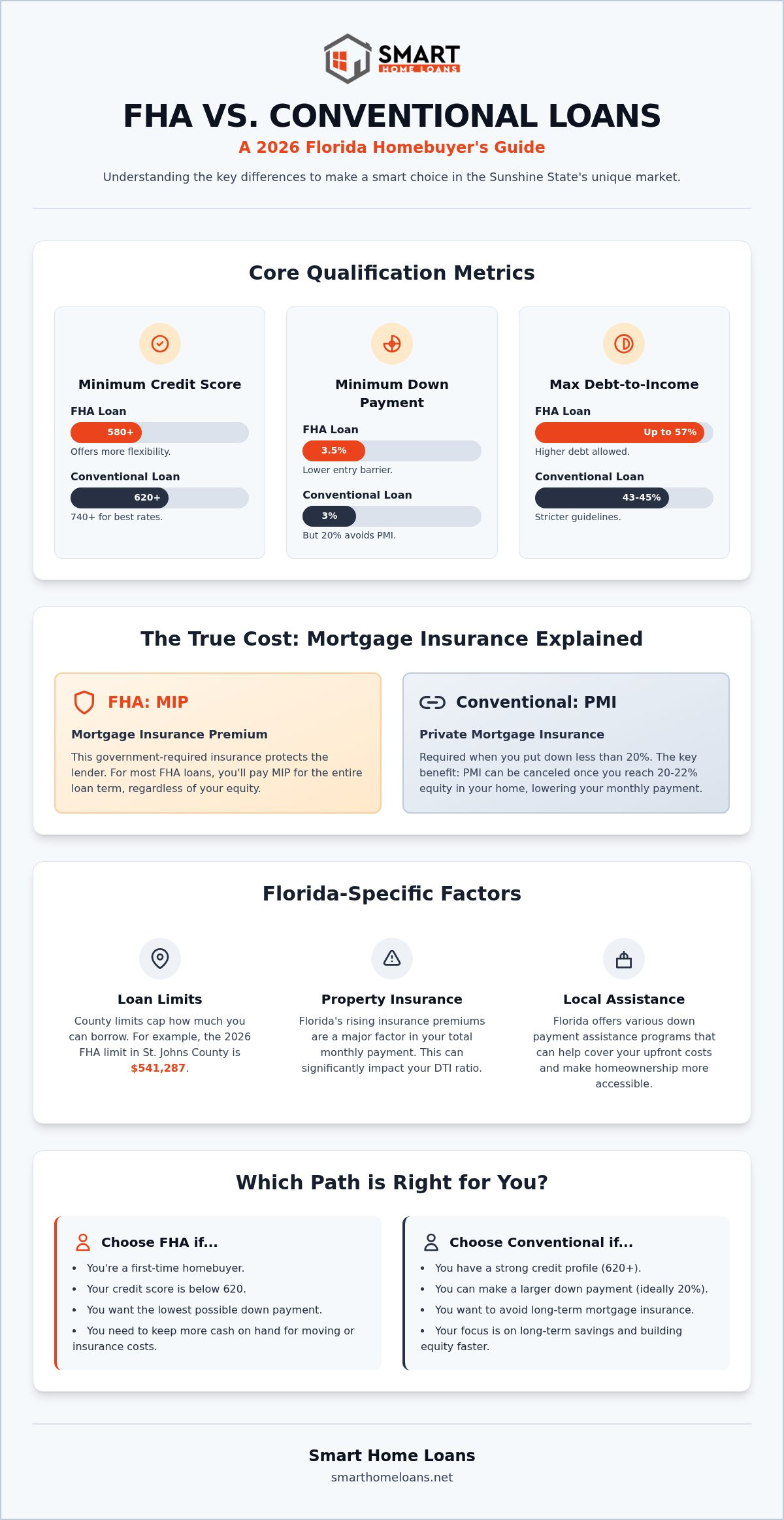
An FHA loan is a mortgage backed by the federal government. Specifically, it is an FHA insured loan, which means the government protects the lender if a borrower defaults. This safety net allows lenders to be more flexible with your application. It’s a proactive solution for many Florida residents. You can often qualify with a credit score as low as 580 and a down payment of just 3.5%.
This program is a fantastic tool for:
- First-time buyers looking for a lower entry cost.
- Buyers with recent credit setbacks who need a second chance.
- Those who want to keep more cash in their pockets to cover Florida’s high property insurance premiums.
What is a Conventional Loan in Florida?
Conventional loans are the most common type of mortgage in the Sunshine State. They aren’t insured by the government. Instead, they follow guidelines set by private entities like Fannie Mae and Freddie Mac. Because there’s no government backing, lenders usually look for a credit score of 620 or higher. If you put down less than 20%, you’ll pay private mortgage insurance (PMI).
Conventional loans offer more long-term flexibility than FHA options. You can eventually cancel your PMI once you build enough equity in your home. This makes it a popular choice for Florida buyers with established credit who want to avoid permanent mortgage insurance premiums. It’s often the faster path to building real wealth through your property.
Deciding which path to take depends on your 2026 goals. Are you looking for the lowest possible upfront cost, or are you focused on the lowest long-term monthly payment? We’ll help you weigh these factors against your specific credit profile and the current Florida market conditions.
Qualification Comparison: Credit Scores and Debt Ratios
Understanding your numbers is the first step toward confidence. When comparing an FHA vs conventional loan Florida, your credit score and debt-to-income ratio are the two biggest keys. These numbers decide not only if you qualify but how much you’ll pay every month. It’s helpful to look at the different kinds of loans available to see where you stand before you start touring homes in Saint Augustine.
| Feature | FHA Loan | Conventional Loan |
|---|---|---|
| Minimum Credit Score | 580 (for 3.5% down) | 620 |
| Max Debt-to-Income (DTI) | Up to 57% | Typically 43% – 45% |
| Down Payment | As low as 3.5% | As low as 3% |
Credit Score Realities for Saint Augustine Buyers
Don’t panic if your score isn’t perfect. FHA loans are famous for their flexibility. If your score is right on the edge, lenders can use manual underwriting to look at your full financial picture. This means they consider your history of on-time rent or utility payments rather than just a three-digit number. On the other hand, conventional loans are more sensitive to your score. A score of 740 or higher is the “gold standard” here. It unlocks the lowest interest rates and significantly cheaper private mortgage insurance. If you’re currently under the 580 mark, we can help you with credit repair strategies to bridge the gap and get you mortgage-ready.
Managing Debt-to-Income (DTI) Ratios
Your Debt-to-Income ratio (DTI) is the percentage of your gross monthly income used to pay your debts. Think of it as a snapshot of your monthly breathing room. FHA loans are incredibly forgiving in this area. They often allow for a DTI as high as 50% or even 57% if you have enough cash in the bank. Conventional loans are much stricter. They usually cap your debt at 43% to 45% to ensure you aren’t overextended.
This matters deeply for Florida buyers in 2026. Our state’s unique property insurance costs and rising taxes eat into your monthly budget. A conventional lender might see those high insurance premiums as a risk and deny your application. However, an FHA loan’s higher DTI ceiling might give you the extra room needed to cover those essential Florida costs. We’ll help you run the numbers to see which path keeps your budget safe and your goals on track.
Florida-Specific Factors: 2026 Loan Limits and Property Costs
Your homebuying journey in the Sunshine State often begins with a single number: the loan limit. These limits act as a filter. They quickly narrow down your options based on the price of the home you want. In the FHA vs conventional loan Florida comparison, knowing where these lines are drawn in 2026 is essential for staying within your budget. If you’re looking at a property that exceeds these local caps, you might find yourself needing a Jumbo loan instead.
Florida’s real estate market is diverse. A budget that works in Saint Augustine might look very different in Miami-Dade or Monroe County. Because property values vary so much across the state, the government adjusts loan limits by county to keep housing accessible. Understanding these local nuances helps you avoid surprises when you’re ready to make an offer.
2026 Loan Limits in St. Johns and Duval Counties
For 2026, most Florida counties, including St. Johns and Duval, follow the standard “floor” for loan limits. For a single-family home, the FHA loan limit is $541,287. If you’re looking at a conventional loan, the limit is much higher at $832,750. This gap is a major factor for many local buyers. If you’ve found a beautiful home in Saint Augustine for $600,000, a standard FHA loan won’t cover the full amount. In that case, a conventional loan becomes the more practical choice unless you’re prepared to make a much larger down payment.
When a home’s price goes above that $832,750 mark, you enter “Jumbo territory.” These loans often have stricter requirements and higher down payments. We help our neighbors navigate these limits every day to ensure they don’t fall in love with a home that doesn’t fit their chosen loan program.
The ‘Florida Factor’: Insurance and Taxes
In Florida, your mortgage payment is about more than just principal and interest. You have to account for the “Florida Factor.” This includes our unique homeowners insurance market and property tax structure. Insurance premiums in Florida have seen significant shifts recently. These costs are often bundled into your monthly escrow payment. A higher insurance bill means a higher DTI ratio, which can impact your loan approval. You can learn more about how these requirements work from the Consumer Financial Protection Bureau on FHA loans.
Property taxes also catch new buyers off guard. In Florida, the “Save Our Homes” cap protects current residents from huge tax spikes, but that cap resets when a home is sold. This means your taxes will likely be higher than what the previous owner paid. Additionally, FHA appraisals are often stricter about a home’s condition. They look closely at things like roof life and electrical systems, which are critical in our humid, storm-prone climate. Having a local Saint Augustine expert on your side ensures these estimates are accurate from the start.
The True Cost: Mortgage Insurance (MIP vs. PMI)
Mortgage insurance often feels like a hidden tax, but it’s really the bridge that gets you into your home sooner. When you weigh an FHA vs conventional loan Florida, you have to look at the “hidden” numbers. These aren’t just interest rates. They are the insurance premiums that protect the lender while you build equity. Understanding how these costs work in 2026 will help you avoid overpaying for your Saint Augustine home in the long run.
Insurance isn’t a penalty. It’s a tool that allows you to buy a home with a small down payment. However, the way you pay for that tool varies wildly between loan types. One stays with you for decades, while the other can be cancelled as your home’s value grows. We’re here to help you do the math so you can keep more money in your pocket every month.
FHA’s Lifetime Mortgage Insurance
FHA loans require a Mortgage Insurance Premium (MIP). This comes in two parts. First, there’s an upfront premium of 1.75% of your total loan amount. Most Florida buyers choose to roll this cost into their loan balance rather than paying it at closing. While this saves you cash upfront, it increases your total debt and monthly interest. Second, you’ll pay an annual premium, which is typically 0.55% of the loan, broken into monthly installments.
The catch with FHA is its staying power. If you put down the minimum 3.5%, that monthly MIP stays for the entire life of the loan. It doesn’t matter if your home doubles in value. The only way to remove it is to refinance into a different loan type later. This permanent cost can eat into your long-term equity, making it a “starter” strategy for many rather than a forever plan.
The Conventional Advantage: PMI Cancellation
Conventional loans use Private Mortgage Insurance (PMI). The big advantage here is flexibility. Unlike FHA, PMI isn’t permanent. It is designed to automatically drop off once your loan balance reaches 78% of the original home value. You can even proactively ask your lender to remove it once you hit 80% equity. In a growing market like Florida, your home’s appreciation can help you reach this milestone much faster than scheduled payments alone.
For many Saint Augustine residents, conventional loans are the cheaper long-term play. You aren’t stuck with a “forever” insurance bill. If you have the credit score to qualify, avoiding the lifetime MIP of an FHA loan can save you tens of thousands of dollars over the years. We can help you compare your monthly payment options to see exactly how much you could save by choosing the right insurance path.
Which one should you choose? If your credit is still a work in progress, starting with an FHA loan to secure your home now is often the right move. You can always plan to refinance into a conventional loan once your credit improves or your home value rises. It’s all about matching the loan to your current reality while keeping an eye on your future wealth.
Choosing Your Path: Down Payment Assistance and Next Steps
Deciding on an FHA vs conventional loan Florida program is easier when you don’t have to bring a mountain of cash to the closing table. Many buyers feel stuck because they have the income but lack the savings for a down payment. In 2026, Florida offers some of the most robust assistance programs in the country. These programs are designed to bridge the gap between your current savings and your homeownership goals. We’re here to help you navigate these local treasures.
Florida’s housing market is fast-paced, but you don’t have to navigate it alone. Whether you’re a first-time buyer or looking to move up, there are solutions built for your specific situation. We focus on finding the path that offers you the most security and the lowest out-of-pocket costs.
Local Florida Down Payment Assistance (DPA)
Florida has several programs that can cover your entire down payment and most of your closing costs. The Florida Hometown Heroes Housing Program is a standout in 2026. It offers eligible frontline workers, educators, and military personnel up to 5% of the first mortgage amount, capped at $35,000. This is a 0% interest, deferred second mortgage. Another great option is Florida Assist, which provides up to $10,000 for those who meet specific income limits.
- Hometown Heroes: Up to $35,000 for educators, healthcare workers, and law enforcement.
- Florida Assist: $10,000 for down payment and closing costs as a zero-interest second mortgage.
- HFA Preferred: Offers up to 5% of the home’s price, which can be forgiven over five years.
National lenders often overlook these Florida-specific benefits. Matching these programs with the right loan type requires deep local knowledge. Some DPA programs pair better with FHA’s 3.5% requirement, while others are optimized for Conventional’s 3% first-time buyer path. We make sure you don’t leave money on the table.
The Smart Home Loans Advantage in Saint Augustine
At Smart Home Loans, we act as your proactive problem-solvers. Managed by Sean (NMLS 1734077), our team focuses on the unique needs of Saint Augustine and St. Johns County buyers. We don’t just look at your application; we look at your future. If your credit score is currently holding you back from Conventional terms, our in-house credit repair services can help you build a stronger profile. We see ourselves as a supportive bridge to your major life goals.
Not sure which path to take? Try this quick litmus test:
- Is your credit score below 620? FHA is likely your strongest starting point for approval.
- Is your target home priced above $541,287? You’ll probably need a Conventional loan to stay within local 2026 limits in St. Johns County.
- Do you want to cancel your mortgage insurance eventually? Conventional is the better long-term play for building equity.
Your next step is simple. Get pre-approved to lock in your 2026 Florida home. This gives you the power to shop with confidence and shows sellers you’re a serious buyer. Let’s work together to find the lowest monthly payment and the best program for your family’s needs.
Your Path to a Florida Home Starts Here
Deciding between an FHA vs conventional loan Florida program is a major milestone in your homebuying journey. You now understand how 2026 loan limits in St. Johns County and the nuances of mortgage insurance will shape your monthly payments. Whether you need the credit flexibility of FHA or the equity-building power of a conventional loan, the right strategy is within reach. Don’t let the complexity of property taxes or insurance premiums slow you down.
Smart Home Loans is here to act as your proactive partner and supportive bridge. Managed by Sean (NMLS 1734077), we’re local Saint Augustine mortgage experts who truly care about your success. We provide dedicated credit repair and down payment assistance support to help you overcome any hurdle. We believe homeownership should be accessible, simple, and rewarding for everyone in our community.
Ready to take the next step? Start your Saint Augustine home journey with a neighborly expert-Get Pre-Approved today!
Take the first step toward your new front door. We’re ready to help you win.
Frequently Asked Questions
Is it easier to get an FHA or conventional loan in Florida?
FHA loans are generally easier to secure because they have more flexible qualification rules. You can often qualify with a credit score as low as 580 and a higher debt to income ratio. Conventional loans usually demand a score of 620 or higher and stricter income requirements. When deciding between an FHA vs conventional loan Florida, remember that FHA is designed for accessibility while conventional rewards those with established credit history.
What is the 2026 FHA loan limit for St. Johns County?
The 2026 FHA loan limit for a single family home in St. Johns County is $541,287. This limit is set to ensure that government backed financing remains available for moderately priced homes in the Saint Augustine area. If the home you want costs more than this cap, you may need to look into a conventional loan or a jumbo mortgage. Knowing these local limits helps you filter your home search effectively from the start.
Can I use down payment assistance with a conventional loan in Florida?
Yes, you can absolutely use down payment assistance with a conventional loan. Programs like the Florida Hometown Heroes Housing Program or HFA Preferred are designed to work with both FHA and conventional products. These programs can provide up to $35,000 to cover your upfront costs. We specialize in matching Saint Augustine buyers with the specific assistance program that fits their chosen loan type and long term financial goals.
Does FHA or conventional have a lower interest rate in today’s Florida market?
FHA loans often feature lower base interest rates compared to conventional loans. As of September 2026, national FHA rates are roughly 6.39% while conventional rates in Florida sit closer to 6.89%. However, it’s vital to look at the total monthly payment. FHA loans include a permanent mortgage insurance premium that might make the overall cost higher than a conventional loan once you reach 20% equity and cancel your private mortgage insurance.
How much is the down payment for a first-time buyer in Saint Augustine?
First time buyers in Saint Augustine can expect a minimum down payment of 3.5% for an FHA loan or 3% for specific conventional programs. On a median priced Florida home of $405,000, this equals roughly $12,150 to $14,175. If these numbers feel out of reach, don’t worry. Our team can help you explore down payment assistance programs that can cover these costs entirely, leaving you with more cash for your moving day.
When can I stop paying mortgage insurance on an FHA loan?
For most FHA loans with a down payment of less than 10%, the mortgage insurance premium stays for the entire life of the loan. You cannot stop paying it simply by building equity. The most common way to remove this cost is to refinance your home into a conventional mortgage once you reach 20% equity. This is a strategic move we often help our local Saint Augustine clients navigate as their property values grow over time.
What credit score do I need for a conventional loan in Florida for 2026?
You typically need a minimum credit score of 620 for a conventional loan in 2026. While you can qualify at this level, your interest rate and monthly private mortgage insurance costs will be much higher. To secure the most favorable terms and the lowest possible monthly payment, aiming for a score of 740 or higher is ideal. If your score is currently lower, our proactive credit repair services can help you improve it before you apply.
Does an FHA appraisal differ from a conventional appraisal in Florida?
Yes, an FHA appraisal is more rigorous than a conventional one. FHA appraisers look beyond the home’s value to ensure it meets specific safety and habitability standards. They check for issues like peeling paint, remaining roof life, and proper drainage, which are critical in our humid Florida climate. A conventional appraisal focuses primarily on the fair market value of the property. We help Saint Augustine buyers prepare for these different inspection requirements.