

What if a past credit slip-up didn’t have to stand between you and a Florida sunset from your own front porch? Many aspiring homeowners think a less-than-perfect financial history is an automatic “no,” but that’s often not the case. It’s completely normal to feel a bit anxious about high closing costs or the latest 2026 loan limit changes. You want a clear path, not a bureaucratic headache.
I’m Sean (NMLS 1734077), and I’ve helped many neighbors navigate these exact hurdles. This guide is your roadmap to understanding the FHA home loan requirements Florida demands this year. We’ve simplified the complex rules into a straightforward checklist you can actually use. You’ll learn the specific credit scores, income standards, and property rules needed to qualify. Whether you’re ready to buy today or need a plan to polish your credit first, you’ll find the confidence to take your next step toward homeownership. We’ll cover everything from the 3.5% down payment rules to the new county-specific loan limits for 2026.
Key Takeaways
- Learn how a credit score of 580 can unlock a 3.5% down payment or how to qualify with a score as low as 500.
- Understand the 2026 loan limit increases across Florida and why every FHA-approved home must pass a specific health and safety inspection.
- Get a clear, step-by-step checklist of the FHA home loan requirements Florida buyers need to meet for a successful 2026 closing.
- Discover how professional credit repair and local down payment assistance programs can bridge the gap if you aren’t quite ready to buy yet.
- Identify the exact documentation you need to gather today to streamline your consultation with a local mortgage expert.
Why Florida Homebuyers Choose FHA Loans in 2026
Buying a home in the Sunshine State is a big dream, but the path isn’t always clear. In 2026, many Florida families are looking for ways to bypass the steep hurdles of traditional financing. FHA loans have become a favorite tool for local buyers because they prioritize accessibility over rigid perfection. These loans aren’t just for people with low income. They’re for anyone who wants a more forgiving way to enter the market. Whether you’re eyeing a bungalow in Saint Augustine or a family home in Jacksonville, these loans offer a reliable route to your goal.
The primary reason these loans are so effective is their government backing. The FHA insured loan program reduces the risk for lenders. This allows them to say “yes” more often. When you look at the FHA home loan requirements Florida buyers must meet, you’ll see a focus on stability rather than just high credit scores. This is especially helpful in 2026, as home prices continue to grow across our local communities. It’s about giving you a fair shake at owning a piece of Florida.
The FHA Advantage in a High-Rate Market
Florida’s real estate market can feel intimidating, especially when entry barriers seem to keep rising. FHA loans act as a safe harbor. They provide a predictable structure that helps revitalize neighborhoods from Saint Augustine to the Keys. By offering lower credit score minimums, these loans ensure that hard-working families aren’t locked out of the market due to a few past mistakes. It’s a supportive bridge. It helps you reach your goal of homeownership without the stress of a traditional bank’s “all-or-nothing” approach. This stability is exactly what Florida families need right now.
FHA vs. Conventional: The Florida Perspective
Why choose FHA over a conventional loan? The answer usually comes down to your wallet. Conventional loans often require higher down payments or much higher credit scores to get the best terms. With an FHA loan, you can put down as little as 3.5%. In a competitive market like Saint Augustine, this flexibility is a game-changer. It allows you to compete with other buyers while keeping your savings intact for things like Florida’s rising insurance costs. FHA guidelines are also more forgiving regarding your debt-to-income ratio. This means if you have student loans or a car payment, you still have a great shot at qualifying. Sean (NMLS 1734077) and the team at Smart Home Loans know the local market. We can help you decide which path fits your family’s budget best.
The 2026 Credit Score and Financial Checklist
Let’s talk about the numbers that often cause the most stress for homebuyers. Your credit score and income are the foundation of your mortgage application. In 2026, the FHA home loan requirements Florida lenders look for are specific but surprisingly flexible. These rules are designed to help you succeed, even if your financial past isn’t perfect. Understanding these benchmarks early gives you the power to plan your move with total confidence.
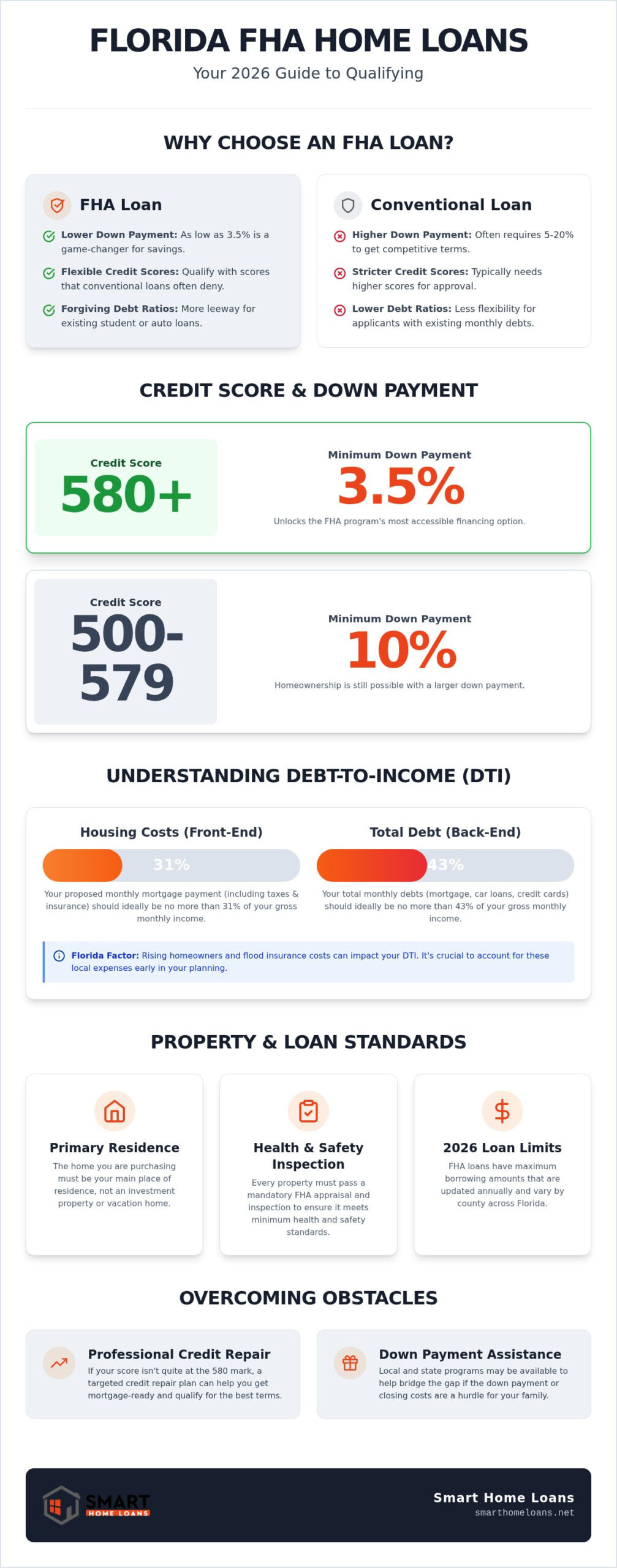
The most important number to remember is 580. If your credit score is 580 or higher, you qualify for the minimum down payment of just 3.5%. If your score falls between 500 and 579, you can still achieve homeownership, but you’ll typically need a 10% down payment. It’s a fair trade-off that keeps the door open for thousands of Florida families who might be rejected by conventional banks. If your score isn’t quite where you want it to be, we can help you with credit repair for mortgage readiness to get you back on track.
Understanding Your Credit Benchmarks
Don’t rely solely on the “free” scores you see on your smartphone apps. Lenders use a specific mortgage-ready scoring model that might look a bit different. While 580 is the magic number for the lowest down payment, lenders also look for “compensating factors” if your score is borderline. This could include having a large amount of cash in savings or a long history of on-time rent payments. The Consumer Financial Protection Bureau on FHA loans explains that these flexible standards are exactly what make the program so accessible for first-time buyers. If you want a deeper walkthrough of every financial benchmark you’ll need to meet, our detailed guide on how to qualify for an FHA loan in 2026 covers each requirement step by step.
Debt-to-Income (DTI) Ratios for 2026
Your DTI ratio is a simple comparison of how much you earn versus how much you owe. Generally, FHA guidelines suggest a “front-end” ratio of 31% for housing costs and a “back-end” ratio of 43% for total debt. However, Florida’s unique market adds a small twist. Rising costs for homeowners and flood insurance can quickly impact your DTI. Since lenders include insurance premiums in your monthly payment calculation, it’s vital to account for these local expenses early. If your ratio is tight, paying off a small credit card or car loan before you apply can create the breathing room you need.
Beyond the scores and ratios, you’ll need to prove your financial stability. Prepare to show a steady two-year employment history. Lenders want to see that your income is reliable and likely to continue. You’ll need to gather your W-2s, the last two years of tax returns, and your most recent pay stubs. If you’re self-employed, don’t worry. You can still qualify by providing detailed profit and loss statements. Having these documents ready to go will make your Florida FHA journey much smoother and faster.
Florida Property Standards and 2026 Loan Limits
Your financial readiness is only half of the equation. The house you choose must also meet the FHA home loan requirements Florida appraisers use to protect your investment. The government wants to ensure that every home is safe, secure, and structurally sound from day one. This means the property itself undergoes a rigorous health and safety inspection during the appraisal process. If you’re looking at charming older homes in Saint Augustine or coastal properties, pay close attention to the details before you sign a contract.
It is also vital to remember that FHA loans are for primary residences only. You must plan to move into the home within 60 days of closing and live there for at least one year. These loans aren’t designed for vacation rentals or fix-and-flip investment properties. This focus helps Florida families compete in a crowded market by prioritizing people who actually want to live in our local communities.
HUD Property Requirements in Florida
Common Florida deal-breakers often involve the roof, HVAC systems, or peeling exterior paint. If a roof has less than two years of life remaining, it likely won’t pass the appraisal. Peeling paint is a major red flag in homes built before 1978 due to lead-based paint concerns. Don’t confuse an FHA appraisal with a standard home inspection. The appraiser looks for HUD compliance and safety. An inspector looks for every tiny defect. For condo buyers, the entire complex must be on the FHA-approved list. This can be a hurdle in Florida, so check the list early in your search.
2026 Florida FHA Loan Limits Breakdown
For 2026, the standard FHA loan limit for a single-family home in 51 of Florida’s 67 counties is $541,287. This limit reflects the steady appreciation in our real estate market. However, limits are much higher in high-cost areas. Monroe County, for example, has the highest limit at $990,150. If you are looking at multi-unit properties to live in one side and rent the other, the limits increase significantly:
- 2-unit property: $693,050
- 3-unit property: $837,700
- 4-unit property: $1,041,125
Staying within these limits is crucial for your approval. If the home price exceeds these amounts, you might need to look at other options like Jumbo loans. Sean (NMLS 1734077) can help you look up the specific limit for your target county to ensure your dream home fits the 2026 guidelines perfectly.
Overcoming Obstacles: Credit Repair and Assistance
Meeting the FHA home loan requirements Florida expects can feel like a mountain to climb. Maybe your credit score is just shy of the 580 mark. Perhaps you’re worried about a past financial setback. Don’t let these hurdles stop you. At Smart Home Loans, we believe every obstacle has a solution. We don’t just tell you what the rules are; we help you meet them. Our goal is to turn your “no” into a “yes” through proactive problem-solving and local expertise.
We know that life isn’t always a straight line. If you’ve faced a bankruptcy or foreclosure, you aren’t permanently barred from homeownership. FHA guidelines are remarkably forgiving. Usually, you can apply for a mortgage just two years after a Chapter 7 bankruptcy discharge. If you’ve faced a foreclosure, the waiting period is typically three years. We take a “can-do” approach to these situations. Sean (NMLS 1734077) is here to help you build a realistic timeline for your return to the market.
Fixing Your Credit to Buy a House
Our team specializes in credit repair to get you mortgage-ready. We don’t just look at the number; we look at the story behind it. We identify and dispute errors on your report that might be dragging your score down. These mistakes are more common than you might think. We also use a process called rapid rescoring. This is a fast-track shortcut that can update your credit profile in just a few days rather than months. To keep your score moving in the right direction, follow these simple habits:
- Keep balances low: Try to use less than 30% of your available credit limit.
- Avoid new debt: Don’t open new credit cards or take out car loans while you’re preparing to buy.
- Pay on time: Even one late payment can have a heavy impact on your score.
Down Payment Assistance in Florida
Saving for a down payment is often the biggest challenge for Florida families. Thankfully, you don’t have to do it alone. The Florida Housing Finance Corporation offers several state-level programs designed to help with down payments and closing costs. There are also local grants specific to Saint Augustine and St. Johns County. These programs pair perfectly with the FHA home loan requirements Florida buyers must meet. They can significantly reduce the total cash you need at the closing table, making homeownership much more affordable.
If you’re worried that your savings or your score won’t make the cut, reach out to us. We can help you find the right assistance programs and create a plan to polish your credit. Start your credit repair journey today and see how close you really are to opening the door to your new Florida home.
Starting Your Florida FHA Journey with Smart Home Loans
You’ve checked the boxes. You’ve reviewed the 2026 limits. Now, it’s time to turn that knowledge into a new set of house keys. Navigating the FHA home loan requirements Florida sets doesn’t have to be a solo mission. In fact, it shouldn’t be. Having a dedicated advocate like Sean (NMLS 1734077) by your side makes the entire process feel less like a hurdle and more like a simple walk to your new front door. We specialize in making the complex feel easy and accessible for every Florida family.
Before you start touring homes in Saint Augustine or browsing listings online, you need to gather your 2026 documentation. Having these items ready will speed up your journey significantly. A well-organized file shows lenders you’re serious and prepared. Start by organizing these essentials:
- Identification: A valid driver’s license or state ID for all borrowers.
- Income Verification: Your two most recent W-2s and pay stubs from the last 30 days.
- Bank Statements: The last two months of statements for all checking and savings accounts to verify your down payment funds.
- Tax Returns: Your complete federal tax returns from the last two years.
Your Pre-Approval Roadmap
A pre-approval letter is your golden ticket in the competitive Florida real estate market. It tells sellers and agents that you’ve already met the initial FHA home loan requirements Florida lenders look for. During our initial consultation, we’ll perform a credit pull to see exactly where you stand. Don’t let this part scare you. It’s a necessary step to give you a clear, honest picture of your buying power. From that first application to the final signature on closing day, we provide a clear roadmap so you never feel lost in the paperwork.
The Local Saint Augustine Advantage
Why choose a local broker over a national “big box” lender? The difference is personal. National banks often treat you like a file in a digital queue. They don’t know the unique charm of Saint Augustine neighborhoods or the specific challenges of the St. Johns County market. Sean is a neighborly expert who is deeply committed to our local community. We offer direct communication and a proactive approach to problem-solving. There are no bureaucratic hurdles here. We focus on finding solutions that fit your life. When you work with us, you aren’t just getting a loan. You’re gaining a partner who is invested in your success. Contact us today to start your personalized consultation and take the first step toward your new Florida home.
Take Your Next Step Toward Florida Homeownership
Owning a home in the Sunshine State is more than just a financial goal; it’s about building a solid future for your family. By now, you have a clear understanding of the FHA home loan requirements Florida demands in 2026. You know that a 580 credit score can open the door with just 3.5% down. You also understand how the new county loan limits and property safety standards protect your investment. If you’re worried about your credit score or saving for a down payment, remember that you don’t have to navigate this journey alone.
Smart Home Loans is your local Saint Augustine partner. Managed by Sean (NMLS 1734077), we offer specialized credit repair services and local expertise to help you get mortgage-ready. We bridge the gap between where you are today and the front door of your new home. Ready to start? Contact Smart Home Loans for your FHA pre-approval! Your dream home is within reach, and we’re here to help you grab it. Let’s make 2026 the year you finally move in.
Frequently Asked Questions
What is the minimum credit score for an FHA loan in Florida in 2026?
The minimum credit score for an FHA loan in Florida is 500. However, your score determines your down payment. A score of 580 or higher allows for the minimum 3.5% down payment. If your score falls between 500 and 579, you’ll need to provide a 10% down payment. We specialize in credit repair to help you reach that 580 benchmark quickly. Meeting these FHA home loan requirements Florida lenders look for is easier with a plan.
Can I use an FHA loan to buy a condo in Florida?
Yes, you can buy a condo with an FHA loan as long as the entire project is on the FHA-approved list. This is a common hurdle in Saint Augustine and throughout Florida. The project must meet specific HUD standards regarding owner-occupancy and financial stability. We can help you check the current status of any complex you’re considering. If a condo isn’t on the list, it won’t qualify for FHA financing. Let’s verify your target property today.
How much is the FHA down payment in Florida?
The standard FHA down payment in Florida is 3.5% of the purchase price for borrowers with a credit score of 580 or higher. For those with scores between 500 and 579, the requirement increases to 10%. This flexibility makes FHA loans a popular choice for Saint Augustine families. You can also use gift funds or down payment assistance programs to cover these costs. We’ll help you identify the best way to fund your home purchase.
What are the FHA loan limits for St. Johns County in 2026?
For 2026, the standard FHA loan limit for a single-family home in St. Johns County is $541,287. These limits are updated annually to reflect rising home prices in Saint Augustine and surrounding areas. If you’re looking at multi-unit properties, the limits are even higher. A two-unit home has a limit of $693,050. Knowing these caps helps you narrow your search to homes that fit the FHA home loan requirements Florida guidelines. Let’s find your limit today.
Can I get an FHA loan after a bankruptcy in Florida?
You can definitely qualify for an FHA loan after a bankruptcy in Florida. For a Chapter 7 discharge, you generally need to wait two years. For Chapter 13, you may even qualify while still in the repayment plan if you’ve made on-time payments for at least 12 months. Our credit repair services focus on helping you rebuild your profile during these waiting periods. We’ll help you prepare for a successful application in Saint Augustine.
Does Florida offer down payment assistance for FHA loans?
Yes, Florida offers several programs to help FHA buyers with down payments and closing costs. The Florida Housing Finance Corporation provides state-level assistance, and there are often local grants available in Saint Augustine. These programs are designed to reduce the cash you need at the closing table. We can help you determine which assistance programs you qualify for based on your income and the location of your new home. Let’s explore your local options together.
What property repairs are required for an FHA loan in Florida?
FHA appraisals require the property to meet HUD’s Minimum Property Requirements. Common repairs include fixing peeling paint in older homes, ensuring the roof has at least two years of life, and verifying the HVAC system works correctly. The goal is to ensure the home is safe, secure, and structurally sound. If the home has major safety issues, the seller must fix them before the loan can close. We’ll guide you through this inspection process in Saint Augustine.
How do I start the FHA application process in Saint Augustine?
Start by contacting Sean (NMLS 1734077) at Smart Home Loans for a personalized consultation. We’ll review your credit, income, and goals to build a custom roadmap for your purchase. We are based right here in Saint Augustine and know the local market inside and out. You’ll need to gather your recent pay stubs, tax returns, and bank statements to begin the pre-approval process. Reach out today to take your first step toward homeownership in Florida.
Pingback: FHA Loan with Bad Credit in Florida: Your 2026 Path to Homeownership