

Could tapping your home equity leave you with a mortgage payment that’s harder to manage? That’s the key trade-off to weigh with an FHA cash out refinance Florida homeowners may consider. The new loan pays off your current mortgage, and any remaining proceeds may go to you, but your balance and payment can change.
This guide explains how the process works, which eligibility and equity factors to check, and how to compare potential cash proceeds with the new loan terms and costs. FHA cash-out refinancing is generally limited to 80% of the home’s appraised value. It’s different from an FHA Streamline Refinance, which doesn’t provide significant cash. You’ll also learn what to ask a mortgage professional before deciding whether the numbers fit your budget.
Key Takeaways
- An FHA cash-out refinance replaces your current mortgage. The amount you may receive depends on the new loan, payoff balance, costs, and lender review.
- Use the FHA cash out refinance Florida eligibility checklist to identify which details about your equity, occupancy, property, credit, and income need review.
- Compare estimated net proceeds with the new loan balance and payment before deciding whether accessing equity fits your budget.
- Gather your mortgage, income, asset, debt, and property information, then ask a mortgage professional to confirm current requirements and the documents needed.
FHA Cash-Out Refinance in Florida: What to Know
An FHA cash-out refinance replaces your current mortgage with a new FHA-insured mortgage. If the new loan is large enough to pay off your existing balance and eligible transaction costs, you may receive some remaining equity as cash. The Federal Housing Administration insures loans made by approved lenders, but it doesn’t guarantee approval or set your individual loan terms.
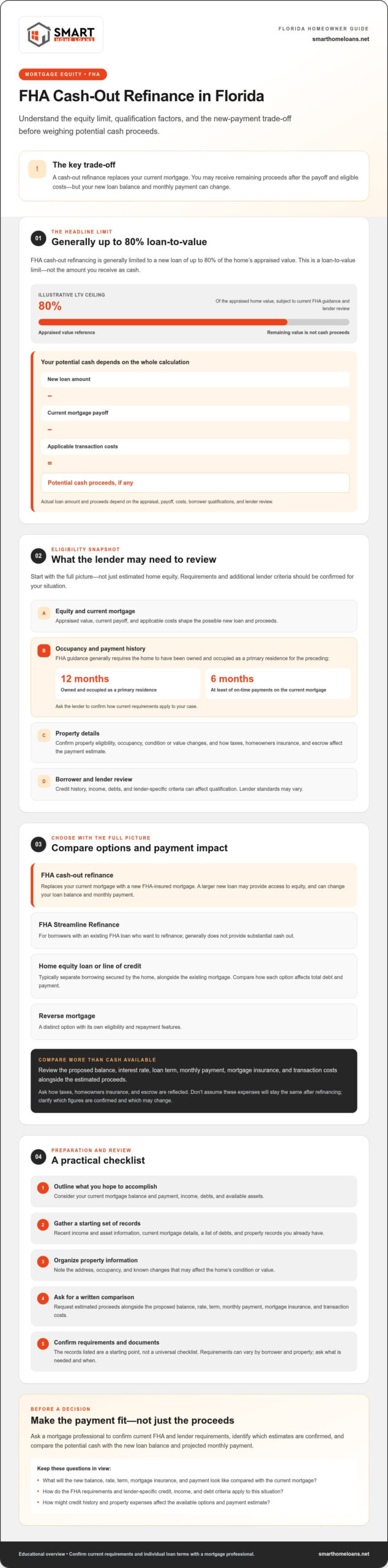
Before estimating proceeds from an FHA cash out refinance Florida homeowners should check current FHA rules and lender requirements. Under current guidance, the maximum loan-to-value ratio for an FHA cash-out refinance is generally 80% of the home’s appraised value. The actual loan amount, available proceeds, interest rate, and payment depend on the appraisal, mortgage payoff, costs, borrower qualifications, and lender review.
Don’t confuse this option with an FHA Streamline Refinance. A Streamline is for borrowers with an existing FHA loan who want to refinance, generally without taking substantial cash out. A cash-out refinance creates a new, larger mortgage to access equity, so it can change both the loan balance and monthly payment.
How FHA cash-out refinancing differs from other ways to access equity
A cash-out refinance replaces your first mortgage. A home equity loan or line of credit, by contrast, is typically separate borrowing secured by the home, alongside the existing mortgage. Each option can affect your total debt and payment differently. Compare the full terms, not just the cash available.
A reverse mortgage is another distinct option, with its own eligibility and repayment features. Review the Florida reverse mortgage guide to understand how it differs. A mortgage professional can help you assess which route may fit your circumstances.
How Florida Homeowners Can Assess FHA Cash-Out Eligibility and Trade-Offs
Start with the full picture, not just your estimated home equity. Your current mortgage payoff, appraised value, occupancy, property eligibility, credit history, income, debts, and lender review can all affect qualification. FHA guidance generally requires a borrower to have owned and occupied the home as a primary residence for the preceding 12 months and to have made at least six months of on-time payments on the current mortgage. Ask the lender to confirm how current FHA loan program requirements apply to your case, along with any additional lender criteria.
To estimate proceeds, subtract the mortgage payoff and applicable transaction costs from the new loan amount. What remains, if anything, is the potential cash you could receive. The amount may be less than expected, so compare the estimate with the replacement loan’s balance and projected monthly payment.
For a Saint Augustine home or another Florida property, ask how the lender will account for property details, taxes, homeowners insurance, and escrow in the payment estimate. Don’t assume these expenses will stay the same after refinancing. Ask which figures are confirmed and which may change.
Questions to answer before deciding whether refinancing makes sense
- How do the proposed balance, rate, loan term, mortgage insurance, and monthly payment compare with your current mortgage?
- Which FHA requirements and lender-specific credit, income, and debt criteria apply to your situation? Confirm thresholds directly, since lender standards may vary.
- How might your credit history affect your options? If it’s a concern, review this FHA guide for Florida borrowers with bad credit.
A mortgage professional can help you review eligibility questions and payment trade-offs. You can also discuss your FHA loan scenario with Smart Home Loans.
FHA Cash-Out Refinance in Florida: Documents, Process, and Next Steps
A clear plan can make the application easier to manage. For an FHA cash out refinance Florida homeowners can start by outlining what they hope to accomplish, then reviewing their current mortgage balance, monthly payment, income, debts, and available assets. Gather basic property details, including the address, occupancy, and any known changes that may affect the home’s condition or value. A mortgage professional can then assess whether your scenario may fit current FHA and lender requirements.
Prepare recent income and asset information, current mortgage details, a list of debts, and property records you already have. This gives the lender a useful starting point, but it isn’t a complete or universal document checklist. Requirements can vary based on the borrower and property, so ask which records are needed and when. For broader context on the steps, see this Florida mortgage process overview.
What to ask a mortgage professional before moving forward
Request a written comparison showing estimated proceeds alongside the proposed loan balance, rate, term, monthly payment, mortgage insurance, and transaction costs. Ask which figures are estimates and what could change them. You can also review general FHA eligibility criteria, then confirm how current requirements and lender-specific standards apply to you.
- Will the process require an appraisal, title review, or proof of occupancy?
- Which financial and property documents should you provide?
- What steps or conditions could affect the final terms or proceeds?
Smart Home Loans offers FHA home loans. A mortgage professional can help clarify the next steps, but a conversation doesn’t guarantee approval or a specific amount of cash.
Take the Next Step With a Clearer Picture
An FHA cash out refinance Florida homeowners consider should be judged by the net proceeds and whether the new payment fits their budget, not just by the equity they’ve built. Check your potential eligibility, account for the mortgage payoff and transaction costs, and compare the proposed balance, term, rate, and mortgage insurance with your current loan. A cash-out refinance replaces your mortgage to access equity; an FHA Streamline Refinance serves a different purpose and generally doesn’t provide substantial cash.
Smart Home Loans offers FHA home loans and serves clients in Saint Augustine. A mortgage professional can help you review your circumstances, understand which requirements may apply, and identify questions to ask before moving ahead. Talk with Smart Home Loans about your Florida FHA options. Approval and proceeds depend on lender review, but a careful comparison can help you take your next step with greater confidence.
Frequently Asked Questions
Can I get an FHA cash-out refinance in Florida if I already have an FHA loan?
Possibly, but having an FHA loan now doesn’t guarantee you’ll qualify for an FHA cash-out refinance. It’s different from an FHA Streamline Refinance, which is designed to refinance an existing FHA loan without substantial cash out. Eligibility depends on current FHA rules, your circumstances, and the lender’s criteria. Ask a mortgage professional to assess your situation, including if your home is in Saint Augustine.
How much cash can I get from an FHA cash-out refinance in Florida?
The amount depends on the home’s value accepted for the loan, the eligible new loan amount, your current mortgage payoff, and applicable transaction costs. These factors determine whether proceeds remain after the existing mortgage is paid. No general estimate can confirm your individual amount. For an FHA cash out refinance Florida assessment, ask a lender to review your property and finances and provide a written estimate.
Do I need to live in the home to qualify for an FHA cash-out refinance?
Occupancy is an important consideration, but your eligibility depends on current FHA rules and how they apply to your circumstances. Tell the lender whether the property is your primary residence, a second home, or a rental, and explain your occupancy history. If the home is in Saint Augustine, provide accurate property-use details so the lender can confirm which requirements apply.
Is an FHA cash-out refinance better than a home equity loan?
Neither option is automatically better. A cash-out refinance replaces your current mortgage, while a home equity loan is separate borrowing that may leave the existing mortgage in place. Compare written estimates for the payment, total borrowing costs, and terms, and consider whether changing your current mortgage makes sense. Your cash needs and existing loan terms also matter, so weigh the full picture before deciding.