

When you’re researching commercial mortgage Florida options, the right financing depends on more than the loan label. Property use, income, borrower finances, and your business plan all help shape which financing path may fit.
You can make the process more focused by preparing key details before exploring options. This guide explains how commercial mortgages work, what lenders commonly review, and how to organize your project information. Use it to connect the property’s intended use with its income potential, costs, and your repayment plan.
Key Takeaways
- Match financing to the property’s intended use, whether you’re buying, refinancing, developing, or improving commercial real estate.
- Assess income, borrower readiness, and financing structure before applying for a commercial mortgage Florida property.
- Understand how net operating income, debt-service coverage ratio, and loan-to-value help lenders evaluate a financing request.
- Organize your business plan, property details, and income projections, then review zoning, insurance, flood exposure, and local requirements.
What a commercial mortgage in Florida can finance, and how property use matters
A commercial mortgage is financing secured by commercial real estate. Unlike a home mortgage, which is generally tied to a residence, it can support a business or investment property. The property helps secure the loan. For an overview of its structure and typical uses, see What is a Commercial Mortgage?
Borrowers may use this financing to acquire a property, refinance existing debt, fund development, or make improvements. The best starting point is to define the project and how the property will be used. A commercial mortgage Florida application is assessed in light of details such as property type, occupancy, expected income, and the borrower’s business plan. Eligibility and terms vary by situation.
Which Florida commercial properties may need mortgage financing?
Commercial properties may include office buildings, retail spaces, industrial facilities, mixed-use properties, and multifamily buildings. To understand the financing needs, clarify who will use the space and how the property will generate income.
- Owner-occupied: The borrower’s business uses the property, such as a company operating from its own office or facility.
- Investment property: The borrower holds the property to earn income, often by renting space to tenants.
For an owner-occupied property, business operations and the intended use may be central to the review. For an investment property, rental income, occupancy, and tenant arrangements can be important. Neither category guarantees approval; the property and borrower’s circumstances matter.
For example, a business planning to operate from a Saint Augustine building has a different use plan from an investor buying space to lease. Smart Home Loans offers commercial mortgages for property financing. Start by stating whether your business will occupy the property or tenants will use it, then outline the project and its expected income. This gives the financing discussion a clear foundation.
How to assess a Florida commercial mortgage before applying
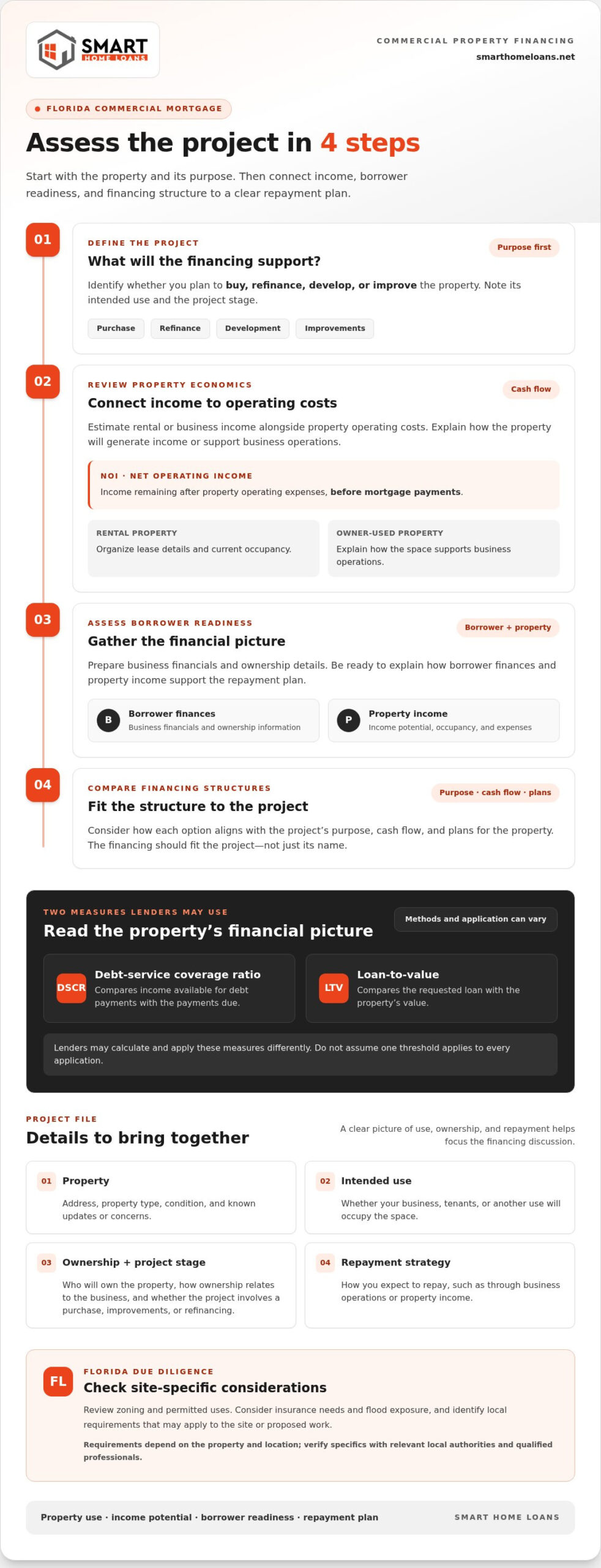
Start with the property and project rather than a product label. Work through these steps to organize the request and identify information you may need:
- Define the project. Specify whether you plan to buy, refinance, develop, or improve the property. Note the intended use and the stage you’re at.
- Review the property economics. Estimate rental or business income alongside operating costs. For a rental property, organize lease and occupancy details; for an owner-used property, explain how it supports business operations. Net operating income (NOI) is income remaining after property operating expenses, before mortgage payments.
- Assess borrower readiness. Gather business financials and ownership details. Be prepared to explain how the borrower’s finances and the property’s income support the repayment plan.
- Compare financing structures. Consider how each option aligns with the project’s purpose, cash flow, and plans for the property. A commercial mortgage Florida borrowers consider should fit the project, not just its name.
Two common measures help frame the property’s financial picture. Debt-service coverage ratio (DSCR) compares income available for debt payments with the payments due. Loan-to-value (LTV) compares the requested loan with the property’s value. Lenders may calculate and apply these measures differently, so don’t assume one threshold applies to every application.
What do lenders commonly review for commercial property financing?
A review may cover the property’s condition, occupancy, income potential, borrower finances, and repayment plan. Prepare property details, income and expense records, business financials, and ownership information. For a rental property, lease details and a record of current occupancy can help explain projected income. Documentation and criteria vary by lender and financing structure. Florida’s statutory language may also be relevant to how certain projects are treated; see the Florida Commercial Property Definitions for context.
Bring the project details and financial information together before comparing options. Smart Home Loans provides commercial property financing. Learn more about commercial mortgage options as you prepare your request.
Florida commercial mortgage next steps: prepare the project and financing request
A well-organized request starts with a clear picture of the project. Before exploring a commercial mortgage Florida option, gather your business plan, property information, projected income, and a concise explanation of how you’ll use the financing. A practical summary can help keep the discussion focused on the property and your repayment plan.
Clarify the essentials:
- Property: Identify the address, property type, condition, and any known updates or concerns.
- Intended use: Explain whether your business will occupy the property, tenants will use it, or the space will serve another purpose.
- Ownership: Outline who will own the property and how ownership relates to the business.
- Project stage: Note whether you’re evaluating a purchase, planning improvements, or refinancing an existing property.
- Repayment strategy: Describe how you expect to repay the financing, such as through business operations or property income.
Include Florida-specific due diligence in your project planning. Review zoning and permitted uses, consider how insurance needs and flood exposure could affect the property plan, and identify local requirements that may apply to the site or proposed work. Requirements depend on the property and location, so verify specifics with relevant local authorities and qualified professionals. Addressing open questions early can help you prepare a more complete financing request.
What should Florida borrowers clarify before requesting commercial financing?
Be ready to connect the property, intended use, ownership structure, project stage, and repayment strategy. Smart Home Loans provides commercial property financing to support property needs. Organize these details to make your financing discussion more focused. Approval and terms depend on the financing review.
Explore commercial mortgage options with Smart Home Loans.
Turn your property plans into a financing conversation
You don’t need to have a complete application ready to start organizing your plans. Write down what you want the property to do, the stage your project has reached, and what you need the financing to support. This creates a useful starting point for comparing financing paths.
If you’re considering a commercial mortgage Florida project, Smart Home Loans provides commercial mortgage financing through its brokerage, managed by Sean, NMLS ID 1734077. Share your project details and explore financing options for your commercial property.
Discuss your Florida commercial financing needs with Smart Home Loans. Start with your property plan, intended use, and available financial information.
Frequently Asked Questions
Can a small business get a commercial mortgage in Florida?
Yes. A small business may seek commercial financing in Florida, and there’s no universal minimum business size. Approval and structure depend on the property, borrower finances, intended use, and lender criteria. For a commercial mortgage Florida request, a small company purchasing its own workspace can prepare a clear use plan, business financial information, and a concise project summary before exploring financing options.
Can an LLC apply for a commercial mortgage?
Yes, an LLC may apply for commercial property financing. A lender’s review may consider ownership, financial records, guarantees, and other documentation, which can vary by transaction. Before signing, understand whether the LLC, its members, or another party would be legally responsible for repayment. For questions about your entity’s obligations or structure, review the specifics with qualified legal counsel.
How much down payment do I need for a commercial mortgage in Florida?
There’s no single down payment that applies to every commercial mortgage in Florida. The required borrower contribution can vary with the property, financing structure, borrower profile, and loan terms. Review the project’s expected income, expenses, and available capital before discussing options. Knowing what you can contribute helps frame the financing conversation without assuming a particular amount.
Are commercial mortgage rates fixed or variable?
Commercial financing may have different rate structures, depending on the lender and loan terms. A fixed rate generally stays unchanged for the agreed period, while a variable rate may adjust over time. Compare how the rate is set, when it could change, the repayment schedule, and any applicable fees. For a Saint Augustine property, include these details when comparing financing options.