Could one home in St. Johns County qualify for USDA financing while another nearby address doesn’t? That’s why USDA loan eligibility St. Johns County isn’t a simple countywide yes-or-no. USDAProperties.com estimates that about 88.6% of the county qualifies, but eligibility still needs to be checked for the specific property address. It’s also important to understand how household income, credit, and debts factor into borrower eligibility.
This guide breaks the process into practical steps. You’ll learn how property eligibility differs from borrower eligibility, what the 2026 income limits mean, and how USDA Guaranteed and Direct loans differ. You’ll also see what to review before making an offer, including the property map, household income, primary-residence requirement, credit, and debt. Smart Home Loans originates USDA loans and can help you review your financing path.
Key Takeaways
- USDA loan eligibility St. Johns County depends on the specific property address, your household, and the loan program, not just the county or listing description.
- Review household income, repayment ability, occupancy, property use, credit history, and recurring debts as separate parts of the borrower and property requirements.
- Before making an offer, identify the home and check its exact address on the USDA eligibility map.
- St. Augustine, World Golf Village, and Fruit Cove are useful places to explore, but the map result for the specific address is what matters.
USDA Loan Eligibility in St. Johns County Starts With the Property Address
USDA eligibility isn’t one pass-or-fail test. It depends on several factors working together: the borrower’s qualifications, household income, the property’s location and use, and the specific USDA loan program. A property’s eligibility doesn’t automatically mean the buyer qualifies, and borrower qualifications alone can’t make an ineligible address eligible.
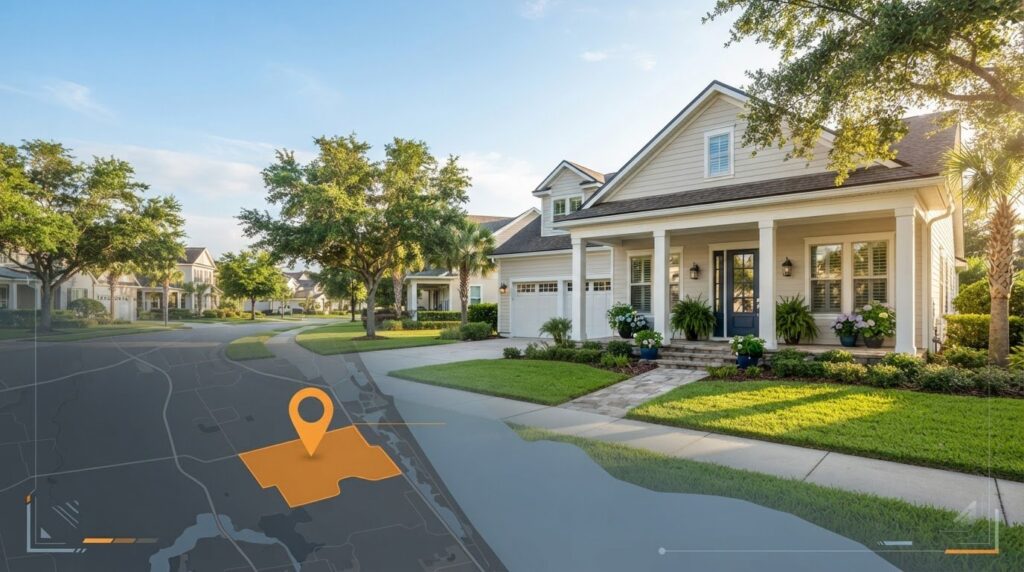
USDA property eligibility is checked by specific address, not by county name or a listing label. A listing described as “USDA eligible” or located in St. Johns County can be a starting point, but it doesn’t establish the result for that home. Use USDA’s property map to check the individual address. Countywide estimates, including the figure reported by USDAProperties.com that approximately 88.6% of St. Johns County qualifies, provide context, not a decision about a particular property.
How USDA Direct and Guaranteed home loans differ
USDA’s Single Family Housing programs include two distinct paths. With a Guaranteed loan, an approved lender makes the loan and USDA provides a guarantee. The Direct program is a separate USDA loan pathway for eligible applicants who meet its specific income and other program criteria. Requirements can differ between the two programs, so qualifying for one doesn’t mean you qualify for the other. Review current USDA guidance for the 2026 rules that apply to your household and chosen program.
To choose a path, first consider your household and financing needs, then compare them with the program requirements and the property’s address result. Smart Home Loans originates USDA loans and can help you understand the program basics as you prepare. For a broader comparison of government-backed options, explore this Florida government-backed home loan guide.
Check These USDA Borrower and Property Requirements Before You Make an Offer
A promising property is only part of the picture. Before making an offer, review your household, how you plan to use the home, and whether the proposed payments fit your finances. USDA requirements can vary by program, so use current guidance for your chosen path rather than assuming one checklist applies to every application.
What household income and repayment ability mean for USDA eligibility
Income review can involve more than the earnings of the person applying. Household income and qualifying income may be assessed differently under program-specific rules. Find out which household members and income sources count for your selected program, and use the USDA’s USDA Property and Income Eligibility Tool as a starting point for current property and income information.
Repayment review considers whether documented earnings can support the proposed housing payment alongside existing monthly debts. Gather records showing your income and make a clear list of recurring obligations, such as installment payments or credit accounts. Credit history and debt levels also inform underwriting, but there isn’t one universal credit-score threshold that guarantees eligibility. A lender reviews the full application under the applicable program’s rules.
- Income: Review household income under your selected program’s current rules.
- Repayment: Consider earnings alongside recurring monthly debts.
- Occupancy: USDA loans require the borrower to occupy the home as a primary residence.
- Property use: Make sure the home’s intended use fits the selected program’s requirements.
Household qualification is about the applicant and finances; property-location qualification is about the home’s specific address. Passing one review doesn’t replace the other. As you prepare to discuss USDA financing, talk with Smart Home Loans.
Verify a St. Johns County Address and Prepare Your USDA Loan Next Steps
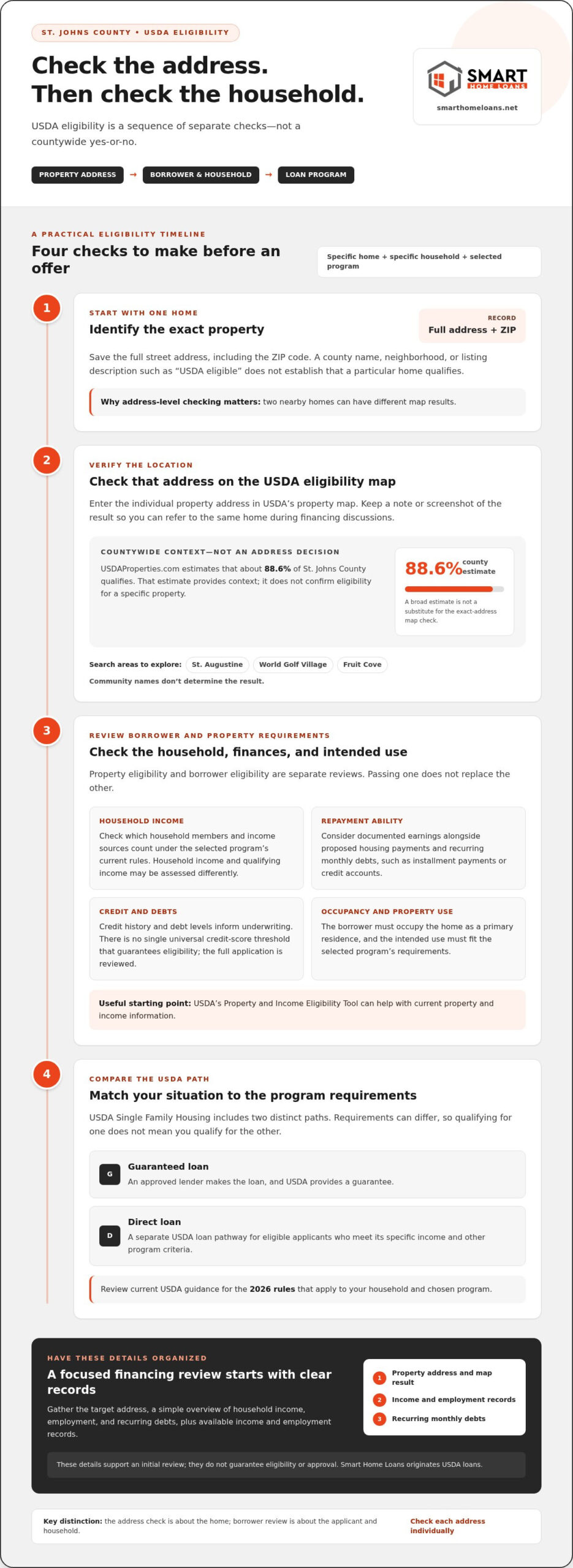
Turn the eligibility questions into a clear sequence. Start with a specific home, confirm the address result, then review your household and finances against the requirements for your chosen USDA program. This approach helps you assess USDA loan eligibility St. Johns County without relying on broad county or neighborhood labels.
- Identify a target property. Save its full street address, including the ZIP code.
- Check the address on the USDA eligibility map. Enter the property address to see whether that location appears eligible.
- Review your borrower criteria. Compare household income, documented earnings, debts, occupancy plans, and other requirements with current program guidance.
St. Augustine, World Golf Village, and Fruit Cove can help narrow your home search, but a community name doesn’t determine whether an individual property qualifies. Check each address, even when two homes are close together. Keep a note or screenshot of the map result so you can refer to the same property during financing discussions.
What to gather before discussing USDA financing
Bring the target address and a simple overview of your household income, employment, and recurring debts. Organize available income and employment records as well. These details make an initial financing conversation more focused, though they don’t guarantee eligibility or approval. Smart Home Loans originates USDA loans and can help you understand next steps. Reviewing the Florida mortgage process from pre-approval to closing can also show how eligibility review fits into the broader purchase timeline.
Ready to talk through your options? Discuss your USDA financing path with Smart Home Loans and bring the property and household details you’ve gathered.
Take Your Next Homebuying Step With a Clear Plan
Your next step doesn’t need to lock you into one home or one financing path. Use what you’ve learned to shape a practical plan, then adjust it as your search and financial picture become clearer. If an address or borrower requirement doesn’t line up, that information can help you compare options and decide what to explore next. You don’t need every answer before you begin.
For guidance on USDA loan eligibility St. Johns County, Smart Home Loans originates USDA loans and can help you discuss your financing path, including FHA and VA options. Credit repair and down payment assistance are also available services, though they aren’t automatic parts of every USDA loan. Talk through your USDA loan next steps with Smart Home Loans to build a clearer plan.
Frequently Asked Questions
Is a USDA loan only for first-time homebuyers?
No. USDA loans aren’t limited to first-time homebuyers. Your first-purchase status doesn’t by itself determine whether you qualify. The review focuses on the requirements for the particular USDA program, your household and finances, and the home’s intended use. If you’ve owned a home before, include your current situation in your USDA loan eligibility St. Johns County review.
Can I use a USDA loan to buy a manufactured home in St. Johns County?
Possibly, if the home and purchase meet the requirements of the selected USDA program. A manufactured home isn’t automatically eligible just because its address appears in an eligible area. Gather the listing details and exact address, then review the property and program criteria together. Smart Home Loans can discuss USDA financing for your home search around Saint Augustine.
Can I qualify for a USDA loan if I have student loan debt?
Yes, student loan debt doesn’t automatically rule you out. Underwriting considers your required student loan payment along with income and other recurring debts to assess repayment ability. Before discussing financing, gather a current loan statement showing the payment amount and repayment status. The applicable program’s underwriting rules determine how the debt is evaluated.
What happens if a home is just outside a USDA-eligible area?
If the USDA map shows the property outside an eligible area, that home won’t meet USDA’s location requirement, even if it’s close to an eligible address. You could look for another property or discuss other financing options. Smart Home Loans also offers FHA and VA loans, each with its own qualification requirements.