
Your business may bring in steady revenue, yet tax deductions can make the income lenders see look much smaller. That can make a mortgage for self-employed in St. Augustine harder to plan for, especially when your income changes from year to year.
Lenders commonly assess documented net income, not just business revenue. The records they review depend on your application and loan program. Preparing a clear picture of your finances can help you compare mortgage paths and plan your next steps. This 2026 guide explains how lenders evaluate self-employed income, which tax and business records to organize, and how FHA, VA, USDA, and Jumbo options may fit different buyer profiles. You’ll also learn how to account for the home and its expected costs as you set a budget in St. Augustine.
Key Takeaways
- Lenders may calculate qualifying income differently from your business’s total revenue. Deductions and changing earnings can affect their review.
- Prepare for a mortgage for self-employed in St. Augustine by organizing tax returns, business records, and personal financial documents.
- Keep business and personal transactions clear so your income and records are easier to follow during the application process.
- Compare FHA, VA, USDA, and Jumbo options based on your eligibility and home-buying plans. Smart Home Loans also offers down payment assistance and credit repair services.
Self-Employed Mortgage in St. Augustine: How Lenders Review Your Income
For a mortgage application, self-employed income is income earned through a business, freelance work, independent contracting, or another form of self-employment. Lenders distinguish business revenue, the total money coming in, from qualifying income, the amount supported by records and accepted under the loan program’s rules. A Mortgage loan is repaid over time, so lenders assess whether documented income supports the proposed payment alongside other parts of your finances.
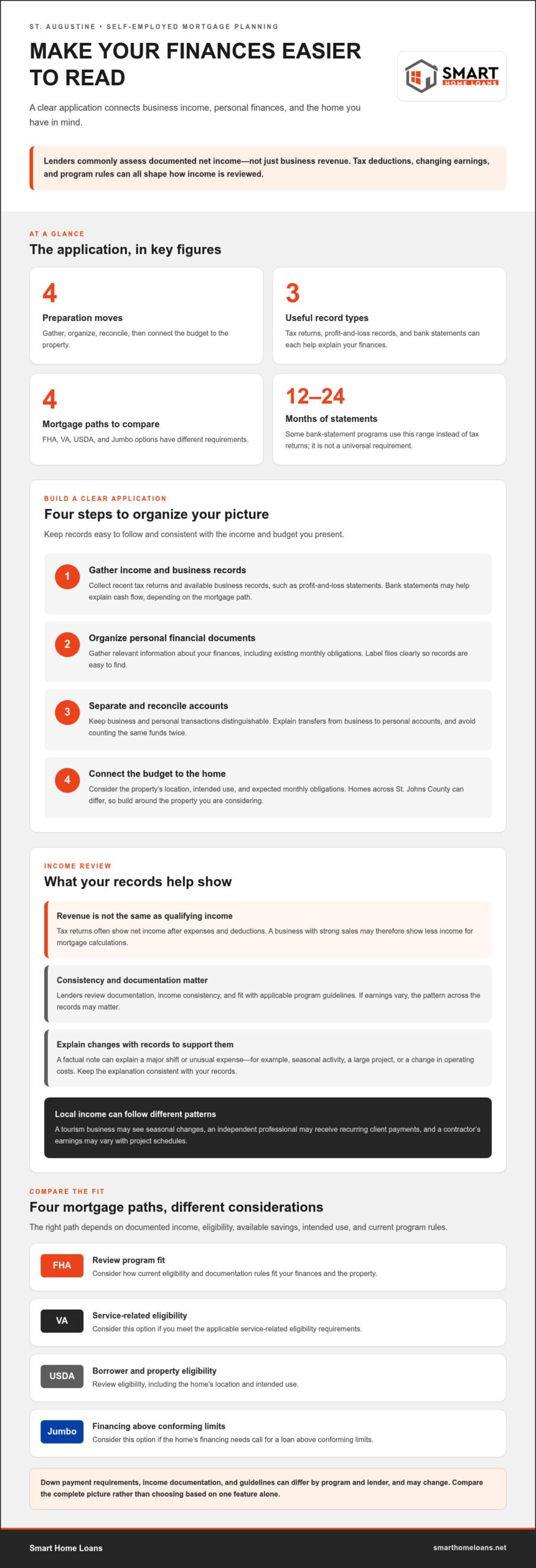
Lenders evaluate self-employed income by reviewing its documentation, consistency, and fit with the applicable program guidelines. Tax returns often show net income after business expenses and deductions, rather than gross revenue. A business with strong sales may therefore show less income for mortgage calculations. That can affect the amount a lender uses, but it doesn’t automatically disqualify you. If your earnings vary, the pattern across the records for your application may also matter.
What St. Augustine business owners and contractors should understand
Self-employed income in the St. Augustine area can take different forms. A tourism business owner may see seasonal changes, an independent professional may receive recurring client payments, and a contractor’s earnings may vary with project schedules. These examples illustrate why it helps to organize records that show how and when your business earns income. The lender’s calculations depend on your documentation, business structure, and mortgage path.
Program and lender guidelines determine which documents and income calculations apply. Some bank-statement programs use 12 to 24 months of personal or business statements instead of tax returns. That is one approach in the market, not a universal requirement, so don’t assume it applies to every mortgage application. Smart Home Loans offers FHA, VA, USDA, and Jumbo loans. Reviewing your income records alongside your home-buying plans can help you compare these options.
Prepare a Strong Self-Employed Mortgage Application in St. Augustine
A well-organized application connects your financial records to your home-buying plans. For a mortgage for self-employed in St. Augustine, prepare documents that show how your business earns income and how your personal finances support the proposed monthly payment.
- Gather income and business records. Collect recent tax returns and available business records, such as profit-and-loss statements. Bank statements can help explain cash flow, depending on the mortgage path.
- Organize personal financial documents. Gather relevant information about your finances, including existing monthly obligations. Label files clearly so you can find records and respond to document requests without confusion.
- Separate and reconcile accounts. Keep business and personal transactions distinguishable. If you transfer business income to a personal account, make sure the records explain the transfers. Avoid counting the same funds twice.
- Connect the budget to the home. Consider the property’s location, intended use, and expected monthly obligations. Homes across St. Johns County can differ, so build your budget around the property you’re considering rather than relying on a broad estimate.
Which records can help explain variable self-employed income?
Tax returns, profit-and-loss records, and bank statements can each help show part of your financial picture. Required documents and calculations vary by lender and loan path. Prepare a factual note about major income changes or unusual business expenses, and keep it consistent with your records. For example, explain whether a shift reflects seasonal activity, a large project, or a change in operating costs.
As you refine your budget, the Florida mortgage process guide explains how preparation fits into the broader purchase process. You can also review your mortgage options with Smart Home Loans.
Choose a Mortgage Path and Take the Next Step in St. Augustine
The right mortgage path depends on more than self-employment status. Your documented income, borrower eligibility, available savings, the home’s intended use, and current program rules all matter. FHA, VA, USDA, and Jumbo loans have different requirements. Compare the complete picture rather than choosing based on one feature alone.
- FHA: Review how the program’s current eligibility and documentation rules fit your finances and the property.
- VA: Consider this option if you meet applicable service-related eligibility requirements.
- USDA: Review borrower and property eligibility, including the home’s location and intended use.
- Jumbo: Consider this option if the home’s financing needs call for a loan above conforming limits.
Down payment requirements and income documentation can differ by program and lender, and guidelines may change. Smart Home Loans offers FHA, VA, USDA, and Jumbo options to support borrowers with different records and goals. If you’re exploring FHA, this FHA loan guide for Florida buyers offers another point of reference.
How to move from document preparation to a mortgage conversation
Bring a simple outline of your business income, current monthly obligations, savings, and the St. Augustine property you have in mind. This gives the conversation a practical starting point. If credit readiness or upfront funds are concerns, Smart Home Loans offers credit repair and down payment assistance. How those services fit your plans depends on your circumstances and the relevant program requirements.
Review your mortgage options with Smart Home Loans to discuss how your documented finances and home-buying goals fit together.
Take Your Next Step Toward a St. Augustine Home
Your self-employed finances don’t need to follow a one-size-fits-all pattern for you to start planning for a mortgage. A clear picture of your goals, income, and financial profile can help shape a practical discussion about your next steps. For a mortgage for self-employed in St. Augustine, focus on the path that suits your circumstances today while accounting for possible changes in your income.
Sean manages Smart Home Loans and holds NMLS ID 1734077. The brokerage offers FHA, VA, USDA, and Jumbo loans, as well as credit repair and down payment assistance. These services can support borrowers as they consider their mortgage options and financial readiness.
Ready to plan your next move? Explore your St. Augustine mortgage options with Smart Home Loans and discuss a practical path toward your home-buying goal.
Frequently Asked Questions
Can I get a mortgage in St. Augustine if I am self-employed?
Yes. Being self-employed doesn’t automatically prevent you from qualifying for a mortgage. Lenders consider documented income, financial obligations, credit, assets, and the selected loan program together. Before applying, organize records that show how your business operates and note any recent changes. Smart Home Loans can discuss how your income may be calculated for a mortgage for self-employed in St. Augustine. Approval depends on the full application and applicable program requirements.
How do mortgage lenders calculate income for self-employed borrowers?
Lenders review your financial documents and apply the calculation rules for the loan program you’re pursuing. Business revenue alone may not show how much income is available for mortgage qualification, since expenses and other factors affect the picture. For example, a busy period with high sales may also involve substantial business costs. The program’s income calculation determines which figures from your records matter.
Can I qualify for a mortgage if my tax returns show low income because of business deductions?
Possibly. Business deductions can reduce the income shown on tax returns, which may make qualification more complicated. The assessment depends on the mortgage program and the documentation it uses, so don’t assume deductions will be added back. Organize records that explain your business finances and compare mortgage paths that may fit your documented profile. Lower reported income alone doesn’t determine the outcome.
What documents should self-employed borrowers prepare for a mortgage application?
Useful examples include tax returns, business financial records, bank statements, and information about ongoing obligations such as recurring debt payments. Exact requests vary by loan path, so one document list won’t apply to every application. Keep records clearly labeled and consistent, and prepare a brief explanation for unusual income changes, such as a delayed client payment or a one-time business expense. This makes your financial picture easier to understand.