

The lower starting payment of an adjustable-rate mortgage can look appealing, but it isn’t automatically the better choice. For a fixed vs. adjustable-rate mortgage in St. Augustine, the key difference is whether your interest rate stays the same or can change after an initial period. Choose based on how long you plan to keep the home and whether your budget can handle a higher payment later.
It makes sense to want predictable payments or to consider a lower initial rate if you may move or refinance. This guide explains how fixed and adjustable rates work, when an adjustable rate can change, and how your plans can shape the decision. You’ll also learn which loan features to compare when weighing the initial rate against possible future adjustments.
Key Takeaways
- Choose predictable payments if long-term budget certainty matters most; weigh an adjustable rate’s introductory period against possible later changes.
- Match the loan to your plans to move or refinance, but don’t build your decision around an assumed future refinance.
- Review when an adjustable rate can change, how often adjustments occur, and how the loan’s caps affect your possible payment.
- Once you’ve narrowed the rate structure, compare it with a suitable financing option, such as an FHA Home Loan from Smart Home Loans.
Fixed vs Adjustable Rate Mortgage: Which is Right for You?
For St. Augustine borrowers, the choice comes down to payment certainty versus a lower starting rate with possible future adjustments. Compare your total monthly housing costs, not just the advertised interest rate.
Closing costs can include lender charges, appraisal, title and settlement services, and prepaid expenses. Lender fees are part of this itemized total, not a single standard charge.
Yes. Property taxes, homeowners insurance, and flood insurance affect your total housing costs, even when a fixed mortgage rate keeps principal and interest steady. Taxes and insurance premiums can change.
Fixed-Rate Payment Predictability
A fixed-rate mortgage locks its interest rate when you take out the loan. Common terms are 15, 20, or 30 years, so you can plan principal-and-interest payments around income without tracking market mortgage rates.
Fixed-Rate Payment Stability
Unlike an adjustable-rate mortgage (ARM), a fixed-rate loan keeps its interest rate unchanged for the full term. This protects your principal-and-interest payment from rising rates, but not your total housing costs: property taxes and insurance premiums can still change your monthly expenses.
Illustrative Payment and Savings Comparison
Introductory Rates and Payment Adjustments
A 5/1 ARM keeps its introductory rate for five years, then adjusts annually for the next 25 years of a 30-year loan. Its lower initial rate differs from fixed-rate certainty: later payments can rise or fall as interest rates change.
| Option | Initial rate | Later rate | Payment pattern |
|---|---|---|---|
| Fixed | Set at loan start | Unchanged | Principal-and-interest stays steady |
| 5/1 ARM | Fixed five years | Adjusts annually | Can change after introductory period |
Choose a fixed rate for long-term payment stability. Consider an ARM only if its adjustment schedule fits your plans and budget.
Choosing a mortgage based on plans to move or refinance
How long you expect to stay in the home can help narrow your options. A fixed-rate mortgage may suit buyers planning a long stay, while an ARM may fit shorter-term plans. When comparing a fixed vs. adjustable-rate mortgage in St. Augustine, consider your expected move date alongside the ARM’s introductory period. If you stay longer than planned, later adjustments could affect your budget.
An ARM may be worth considering if you expect to live in the home for 5 to 10 years and its initial fixed period matches that timeline. But plans can shift. A job change, family needs, or a home that no longer fits could delay your move until after the rate starts adjusting.
Refinancing before the introductory period ends is one possible plan, but it is not guaranteed. A future refinance depends on your finances and the terms available at that time. Don’t choose an ARM based only on the assumption that you’ll refinance before the payment increases. When weighing a fixed-versus-adjustable-rate mortgage in St. Augustine, consider whether you could keep the loan beyond your original timeline.
- Estimate how long you expect to keep the home.
- Compare that timeline with the ARM’s initial fixed period.
- Consider whether your budget could manage adjustments if you stay longer.
- Review the mortgage contract for any prepayment penalty before selling, refinancing, or paying off the loan early.
A 30-year fixed mortgage can suit buyers staying beyond an ARM’s introductory period. An ARM can fit a shorter horizon when its initial rate period aligns with your plans, but account for the possibility of a longer stay and future rate increases.
To compare financing options against your expected timeline, review mortgage options as one step in your decision.
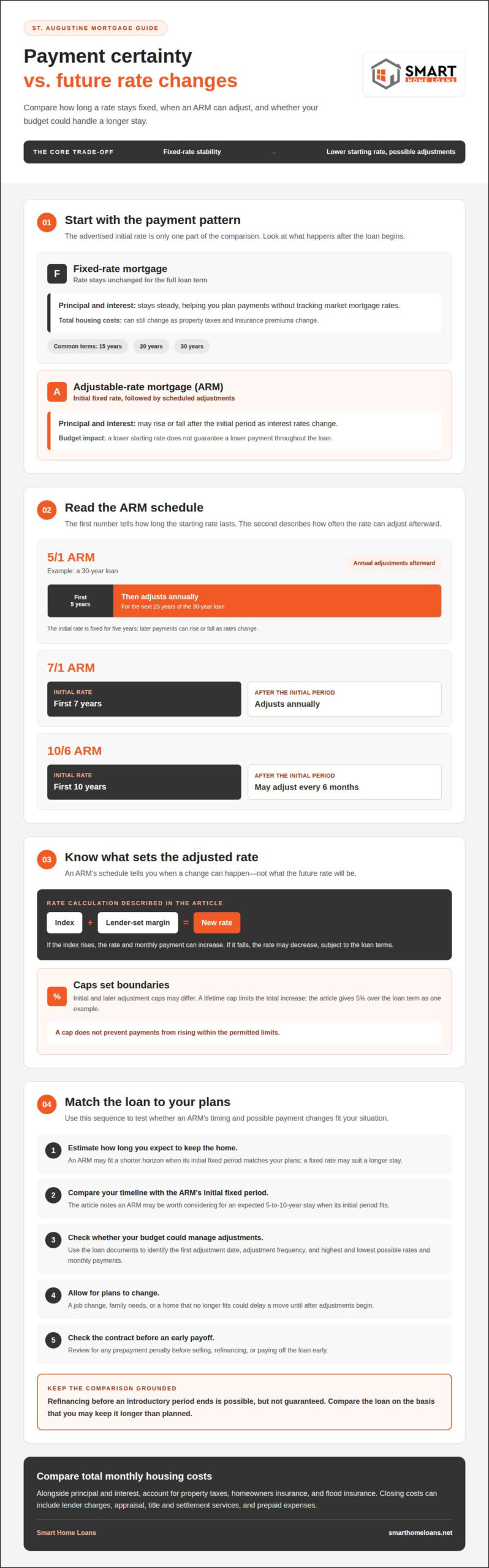
Adjustable-rate mortgage fixed-rate and adjustment periods
An ARM combines an initial fixed rate with later adjustments. Its name shows the timing: a 7/1 ARM holds its initial rate for seven years, then adjusts annually. A 10/6 ARM keeps its starting rate for 10 years, then may adjust every six months.
After the initial fixed-rate period, the lender typically calculates a new rate using an index plus a lender-set margin. If the index rises, the rate and monthly payment can increase; if it falls, the rate may decrease, subject to the loan’s terms. The adjustment schedule shows when changes can happen, not what the future rate will be.
Rate caps limit how much the interest rate can change at an adjustment or over the loan’s life. Initial and later adjustment caps may differ. A lifetime cap can limit the total increase, with 5% over the loan term as one example. Caps set boundaries; they don’t prevent payments from rising within those limits.
Before choosing a rate loan, identify the first adjustment date, how often changes follow, and the highest and lowest possible rates and monthly payments. Then compare the maximum payment with your budget, income, and credit situation. A lower initial rate may suit a planned shorter stay, but consider whether you could manage increases if you keep the home beyond seven years or 10 years.
For a clear comparison, use the loan documents to map each rate period and cap against your expected time in the home. Review your mortgage options alongside those adjustment terms.
Smart Home Loans: FHA Home Loans
Smart Home Loans can help you compare financing options after weighing fixed and adjustable rates against your plans. If an FHA Home Loan is part of your comparison, consider how its terms fit your budget and expected time in the home. You can use the same practical approach to compare VA Loans, USDA Loans, and Jumbo Loans.
Start with your priorities: predictable payments, plans to move or refinance, and your comfort with future rate adjustments. These details keep the comparison focused on financing that fits your situation, rather than the initial rate alone.
Explore the available options and decide what questions matter most for your next step. Visit smarthomeloans.net to contact Smart Home Loans.
Make Your Next Mortgage Decision With Confidence
Base your fixed-versus-adjustable-rate mortgage decision in St. Augustine on the payment pattern that suits your plans, not just the rate that looks attractive today. Before moving forward, write down how long you expect to stay in the home, the payment you can comfortably manage, and how much uncertainty you’re prepared to accept. This gives you a practical starting point for comparing mortgage options.
Smart Home Loans offers FHA Home Loans, VA Loans, and USDA Loans. If you’re exploring one of these options, consider how its terms align with your goals and budget. Start with a clear conversation about what you need from your financing.
Contact Smart Home Loans to discuss your options. You can move forward at your own pace, with a clearer sense of what matters most for your home plans.
Frequently Asked Questions
Can you switch rate structures later?
Yes. You can switch by refinancing into a new mortgage with a different rate structure. Refinancing replaces your existing loan, and the new application and terms determine which options are available. For example, a borrower with an ARM might refinance into a fixed-rate loan before an adjustment, then compare the new loan’s costs and payment with the cost of keeping the current mortgage.
How do ARMs work?
An ARM has an initial rate for a defined period, then adjusts according to the loan’s terms. The adjustment is generally based on an index plus a lender-set margin, subject to the loan’s caps. If the index rises at a scheduled adjustment, for example, the rate may rise within those limits. Read the loan documents to understand the index and margin.
How often can the rate change on an ARM?
The schedule depends on the ARM’s terms. Some loans adjust every six months after the introductory period; others adjust annually. The loan name can offer a clue, but read the adjustment schedule to confirm the first change date and later intervals. This calendar shows when a rate change could affect your monthly payment.
Is a 3-year ARM a good option?
A 3/1 ARM has a fixed APR for three years, then adjusts annually for the next 27 years. It may fit a borrower whose expected time in the home aligns with that initial period and who can handle possible adjustments afterward. Compare that timeline with your moving plans, and consider whether you could keep the mortgage longer than expected.
What are the advantages and disadvantages?
An ARM may offer a lower introductory rate than a fixed-rate mortgage, reducing early payments. The tradeoff is uncertainty: later adjustments may increase the rate and payment. A fixed-rate loan offers a steadier principal-and-interest payment but may start at a higher rate. Compare the initial cost with your ability to manage future changes.