
The right commercial property loan in St. Augustine depends on whether you’re buying, building, refinancing, or financing a property your business will occupy. Commercial real estate financing can support purchases, development, and refinancing for business-use properties such as offices, retail spaces, warehouses, and multifamily buildings. The loan type matters: permanent financing, SBA options, construction loans, bridge financing, and multifamily programs serve different needs.
Commercial financing can feel complex because the right fit depends on the property, its intended use, and the stage of your project. This guide explains commercial mortgages and refinancing, compares common financing types, and outlines what to prepare before applying. You’ll get a clearer picture of which options may align with your plans and what to organize for a financing conversation.
Key Takeaways
- Match financing to the project stage: permanent loans support long-term ownership, while construction and bridge options address shorter transitions.
- Prepare business financial statements, tax returns, a business plan, and owners’ personal financial statements before applying. USDA or SBA real estate lenders commonly request three years of personal and business tax returns.
- For SBA real estate financing, check how much of the property your business will occupy: the threshold is 51% for an existing building and 60% for new construction.
- Compare loan structures by property type, intended use, and repayment needs to narrow down which commercial financing route fits your plans.
Permanent financing and refinancing
Choose financing based on the property’s use and project stage. Permanent loans support long-term ownership; construction and bridge loans serve shorter-term needs.
Small Commercial Property Loans
For a small office, shop, or warehouse, compare owner-occupied financing with loans for investment property. SBA 7(a) real estate loans can have repayment periods of up to 25 years. Construction financing can cover land development and building costs, while bridge financing can help cover renovations or a gap between purchase and long-term financing. Equipment financing spreads equipment costs over its useful life.
Refinancing and Cash-Out Options
Refinancing replaces existing property debt with a new loan. A cash-out refinance may release equity for renovations or business needs, subject to the property’s value and repayment capacity. Compare the new payment structure, loan term, and total borrowing needs with your current debt. Commercial real estate loans can refinance business-use properties, including offices, retail spaces, warehouses, and multifamily buildings.
Property and Loan Evaluation Criteria
Lenders assess the property’s value and whether its income can support debt payments. Debt service coverage compares available income with required loan payments; rental income, vacancies, operating expenses, and lease terms affect that calculation. Prepare current rent rolls and expense records to show the property’s performance. Lenders may also consider the borrower’s finances, intended use, and business occupancy.
Financing Rules, Risks, and Alternatives
In St. Augustine, zoning, flood exposure, insurance costs, and historic-district restrictions can affect permitted use, renovation plans, operating expenses, and lender review. Consider how these factors may shape cash flow and the project timeline. Lenders differ in the property types, occupancy, and loan structures they serve. Local and regional banks, credit unions, national lenders, and SBA lenders may each have different criteria.
Consider the risks and alternatives. Construction delays, weaker rental income, or higher bridge-loan costs can strain repayment. Depending on the need, alternatives may include permanent financing, construction loans, or equipment financing.
Application documents and preparation
Prepare financial records before discussing financing. An organized file helps assess repayment capacity, the property, and your proposed financing.
Down Payment Requirements
Down payment and credit score requirements for a commercial property loan vary. Lenders weigh the property type, occupancy, borrower finances, projected income, and loan structure.
Build a cash plan around the purchase price, closing needs, and funds available after the down payment. For an SBA 504 structure, the borrower contributes the remaining project amount after the third-party lender’s first mortgage and SBA-backed portion. Keep funds accessible and document their source.
Credit Score Requirements
Credit score requirements vary by lender and financing program, so a universal minimum would be misleading. Lenders may review personal credit alongside business performance, existing obligations, payment history, and the property’s ability to support debt.
Before applying, review your credit reports for errors and prepare a brief explanation for any late payments or unusual changes. Consider how taking on new debt could affect your application. Organized financial records help lenders assess the full picture, not just one score.
Documents to Prepare
Gather business financial statements, business tax returns, a business plan, and each owner’s personal financial statements. Lenders commonly request personal and business tax returns from the past 3 years for USDA or SBA real estate loans. Add current rent rolls, leases, property expenses, and purchase or construction details when they apply.
Label files by year and keep figures consistent across documents. A flexible, well-organized application makes gaps easier to spot and questions easier to answer. For help exploring commercial mortgage options, review the financing information available here.
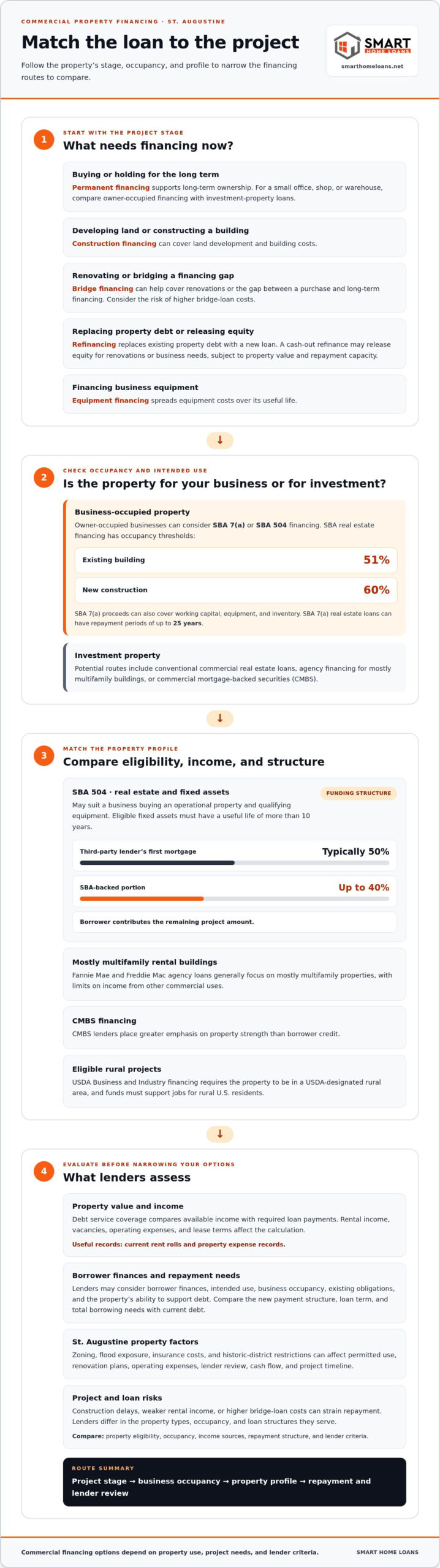
Commercial property loan types
Match financing to the property’s use, income, and project stage. Options differ in occupancy rules, property eligibility, and how repayment is assessed.
What loan options are available for investment properties versus owner-occupied commercial property? Investment properties may fit conventional commercial real estate loans, agency financing for mostly multifamily buildings, or commercial mortgage-backed securities (CMBS). Owner-occupied businesses can consider SBA 7(a) or 504 financing, which is limited to properties occupied by the business owner. SBA 7(a) proceeds can also cover working capital, equipment, and inventory.
An SBA 504 structure combines funding sources: a third-party lender’s first mortgage typically covers 50% of project costs, while the SBA-backed portion can cover up to 40%. The borrower contributes the remaining project amount. SBA 504 can fund eligible real estate and fixed assets with a useful life of more than 10 years. It may suit a business buying an operational property and qualifying equipment.
For rental buildings, Fannie Mae and Freddie Mac agency loans generally focus on mostly multifamily properties, with limits on income from other commercial uses. CMBS lenders place greater emphasis on property strength than borrower credit. USDA Business and Industry financing is another route for eligible projects, but the property must be in a USDA-designated rural area, and funds must support jobs for rural U.S. residents.
Compare property eligibility, occupancy, income sources, and repayment structure before choosing. For financing tailored to your commercial property plans, explore commercial mortgage options.
Smart Home Loans: FHA Home Loans
Smart Home Loans offers FHA Home Loans for readers whose plans involve buying a home, rather than financing a commercial property. FHA financing addresses a different need from commercial mortgages, which support business-use real estate. Clarify whether the property will serve as your residence or business location before choosing a loan path.
For residential financing, Smart Home Loans also offers VA Loans, USDA Loans, and Jumbo Loans. The right option depends on your purchase plans and circumstances. For a business property, Smart Home Loans offers commercial mortgages. Matching financing to the property’s use, income, and project stage helps keep your application and documents relevant.
Contact Smart Home Loans to discuss your residential financing needs.
Take the Next Step With a Clear Financing Plan
Before pursuing a commercial property loan in St. Augustine, define how the property will support your business or investment goals. Smart Home Loans offers commercial mortgages for commercial property financing. For residential plans, it also offers FHA Home Loans, VA Loans, and USDA Loans. Keeping the property’s intended use clear helps you focus on the right financing path and prepare relevant documents.
Make your next step a practical one: outline the property you’re considering, its intended use, and the financing questions you want answered. A focused conversation can help you organize what to explore next. Contact Smart Home Loans today to discuss your financing plans and take the next step with confidence.
Frequently Asked Questions
What types of commercial property loans are available in St. Augustine, Florida?
Commercial property financing options include permanent mortgages, construction and bridge financing, SBA loans, multifamily agency loans, and commercial mortgage-backed securities. A local retailer buying its operating space might compare owner-occupied financing, while an investor considering rental apartments could explore multifamily-focused options. Property use, income, occupancy, and project stage help narrow the choices. Smart Home Loans offers commercial mortgages for business property financing in St. Augustine.
Are SBA 504 or 7(a) loans available for commercial property in St. Augustine?
Yes. Eligibility for these financing options depends on the property’s intended use and the business’s circumstances. A 7(a) loan can also include working capital, equipment, or inventory. A 504 structure can suit eligible real estate or long-life fixed assets, with project funding shared among the lender, SBA-backed portion, and borrower.
What documents and financial information are needed to apply for a commercial property loan?
Start with business financial statements, tax returns, a business plan, and owners’ personal financial statements. Lenders commonly request personal and business tax returns from the past 3 years for USDA or SBA real estate applications. For a commercial property loan in St. Augustine, keep records organized by tax year and align reported income with supporting statements and property income details.
How long does commercial property loan approval and closing typically take in St. Augustine?
Timing depends on how complete the application is and the work needed for underwriting, valuation, title review, and property checks. A purchase with clear financial records may involve fewer review steps than construction or renovation financing, which can require project plans and progress details. Responding promptly to document requests helps keep the application moving.