
A useful starting point for how much house you can afford in St. Augustine is to keep housing costs at or below 28% of your gross monthly income and total monthly debt at or below 36%. Student loan payments count toward that debt, so they can reduce the amount available for a mortgage. Your down payment also matters: with a conventional loan, putting less than 20% down generally means adding private mortgage insurance (PMI) to your monthly costs.
It’s easy to focus on income or a home’s sale price and overlook how existing payments affect affordability. This guide explains how to estimate a comfortable price range by weighing income, student loans and other debts, your down payment, and mortgage insurance. You’ll see how these factors shape your monthly housing budget and help you compare a lender’s potential loan amount with what fits your day-to-day finances in St. Augustine.
Key Takeaways
- Estimate a comfortable price from income you can rely on, then account for debts and the full monthly housing cost.
- Compare down payment choices to see how they affect the amount you borrow and whether PMI may add to monthly expenses.
- Include student loan payments in your budget because they can reduce room for a mortgage, even when your income looks strong.
- Explore whether FHA Home Loans or another available loan option fits your affordability goals with Smart Home Loans.
Down-payment and private mortgage insurance considerations
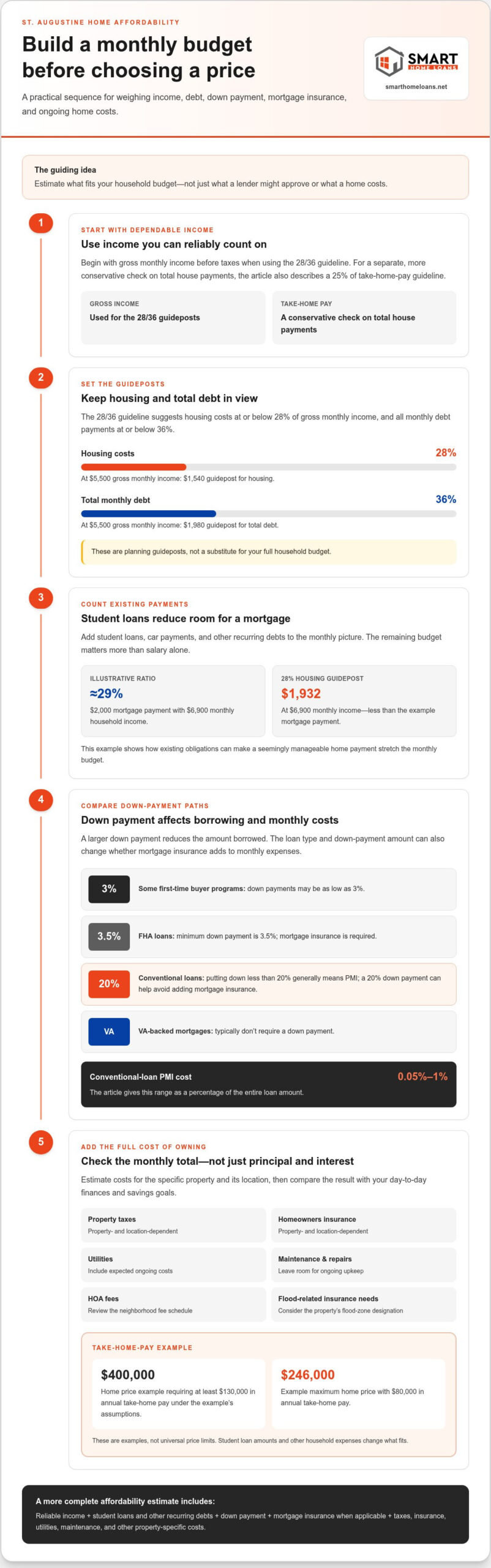
Your down payment changes both the amount you borrow and your monthly mortgage costs. With a conventional loan, borrowers putting down less than 20% generally pay private mortgage insurance (PMI). PMI typically costs between 0.05% and 1% of the entire loan amount. A 20% down payment can help a homeowner avoid adding mortgage insurance to monthly expenses. Some first-time buyer programs allow down payments as low as 3%, while FHA loans require mortgage insurance and a minimum down payment of 3.5%. VA-backed mortgages typically don’t require a down payment.
Build more than principal and interest into your budget. Property taxes, homeowners insurance, utilities, and maintenance all affect the cost of owning a St. Augustine home. Insurance premiums and property taxes depend on the property and its location. Use current estimates for the specific home, and leave room for repairs and ongoing maintenance. A payment that fits before these costs may strain your monthly budget afterward.
How does the cost of living in St. Augustine compare with Jacksonville or other Florida cities? It depends on housing, insurance, taxes, utilities, and transportation. Compare those costs for the home and commute you’re considering rather than relying on a broad city comparison. HOA fees also vary by St. Augustine neighborhood and included services, so review the association’s fee schedule before calculating your total monthly housing cost.
How do flood zones affect home prices, insurance, and mortgage requirements in St. Augustine? A property’s flood-zone designation can affect insurance costs, buyer demand, and the monthly housing budget. Consider the property’s location and insurance needs alongside its price when estimating affordability.
What mortgage assistance programs are available to Florida or St. Johns County homebuyers? Eligible buyers can explore down-payment assistance programs, though eligibility, funding, and loan conditions vary. Include any assistance you qualify for when estimating how much cash you’ll need upfront.
How Will My Debt-to-Income Ratio Affect Affordability?
Your monthly income and debt payments help shape a realistic home budget. A home affordability calculator also uses your down payment to estimate the mortgage amount.
Debt-to-Income Ratios and Lender Guidelines
Debt-to-income ratio compares monthly debt payments with gross monthly income, helping show how much income is already committed. The 28/36 guideline suggests keeping housing costs at or below 28% of gross monthly income and total monthly debt payments at or below 36%. For $5,500 in gross monthly income, those guideposts are $1,540 for housing and $1,980 for total debt. Use them to frame an estimate, not as a substitute for your full household budget.
Debt Ratios and Borrowing Capacity
A higher debt-to-income ratio leaves less monthly income available for a mortgage, which can reduce estimated borrowing capacity. For example, a $2,000 mortgage payment with $6,900 in monthly household income produces a ratio of about 29%; the 28% housing guideline at that income equals $1,932. That difference shows why a home price that looks manageable can stretch the monthly budget once existing debts are included.
Start with income you can reliably count on, before taxes. Enter monthly debt obligations such as student loans and car payments, then add the down payment and estimated housing costs. Adjusting the down payment changes the amount borrowed, while reducing debts can free more room in your estimate. If upfront funds are a constraint, explore down payment assistance as one part of your affordability planning.
Home affordability when carrying student loans
Student loans affect affordability because their monthly payments are already committed to debt. Include those payments in a home affordability calculator alongside income, other expenses, and expected housing costs. The remaining budget matters more than salary alone: regular loan payments can reduce what’s available for a mortgage, even when earnings seem strong.
A 25% take-home-pay guideline offers a conservative way to consider total monthly house payments. Under one example’s assumptions, a $400,000 home requires at least $130,000 in annual take-home pay. With annual take-home pay of $80,000, the example estimates a maximum home price of $246,000. These are examples, not universal price limits. Student loan amounts and other expenses change what fits each household.
What is the median home price in St. Augustine, Florida? A useful median depends on the homes included and the period measured, while your affordability depends on income, debts, and monthly costs. Don’t treat a market median as a personal budget target.
Which St. Augustine neighborhoods have the lowest home prices? There isn’t one lowest-priced choice for every buyer. Prices vary with location, property size, condition, and home type. Compare those factors with your budget rather than choosing a neighborhood by name alone.
For a clearer estimate, enter your reliable take-home income, student loan payment, other recurring debts, and expected housing expenses in a calculator. Then compare the result with your monthly budget, including savings and routine costs. If you’re weighing financing options, explore home loan options that fit your purchase plans.
Smart Home Loans: FHA Home Loans
Smart Home Loans offers FHA Home Loans for buyers considering that financing option as they assess affordability. FHA loans require mortgage insurance, so include that cost in your monthly budget alongside principal, interest, taxes, and homeowners insurance. A realistic estimate should also account for student loan payments and other recurring debts, not just the home’s purchase price.
VA Loans, USDA Loans, and Jumbo Loans are other options to compare with FHA financing. The right comparison depends on your income, existing obligations, available down payment, and the monthly payment that fits your household budget. To discuss which option may suit your plans in St. Augustine, contact Smart Home Loans.
Turn Your Estimate Into a Clear Next Step
Turn your affordability estimate into a financing conversation grounded in your priorities. Decide what monthly payment feels workable alongside your other goals, and identify the trade-offs you’re willing to make on location, home size, or timing. Bring your income, recurring debt payments, savings, and preferred price range to the discussion.
For a clearer answer to how much house you can afford in St. Augustine, focus on a payment that supports your plans after moving, not just the purchase itself. Smart Home Loans offers FHA Home Loans, VA Loans, and USDA Loans for buyers comparing financing options. Discussing your budget and the home you hope to buy can help frame a useful next step.
Contact Smart Home Loans to discuss your options. Take the next step at a pace that feels right for you.
Frequently Asked Questions
How Much House Can I Afford?
To estimate how much house you can afford in St. Augustine, start with a monthly payment that leaves room for regular expenses and savings goals. Then compare homes using their full ownership costs, not just list prices. A lender’s estimate can show what financing may fit, while your own budget sets a comfortable ceiling.
How Do I Budget for a House?
Build your budget around both recurring housing expenses and upfront cash needs. Include mortgage payments, taxes, insurance, utilities, maintenance, and any association fees. Also plan for closing costs, which the article’s U.S. estimate places at about 3-4% of the purchase price. Keep a separate cushion for moving expenses and unexpected repairs after you take ownership.
How much of a down payment do you need for a house?
The required down payment depends on the loan program and your finances, so there isn’t one amount that applies to every buyer. Some first-time buyer programs allow as little as 3% down; FHA loans require at least 3.5%, and VA-backed mortgages typically require no down payment. Compare cash needed upfront with the resulting monthly payment and mortgage insurance.
Is a 30-year mortgage okay if it’s all I can afford?
A 30-year mortgage can make monthly payments more manageable, but compare the total paid over the loan term. Consider whether that payment fits alongside your other financial priorities.
What Salary Do You Need to Buy a $400,000 House?
One example estimates that a $400,000 house requires at least $130,000 in annual take-home pay under its assumptions. Take-home pay is not the same as gross salary, and the estimate changes with debts, loan terms, down payment, and housing expenses. Use your actual monthly obligations to assess whether that purchase price leaves enough room in your budget.