
The lower monthly payment can come with a higher lifetime interest bill. For a 15 vs. 30-year mortgage in St. Augustine, a 15-year fixed loan generally has higher monthly principal-and-interest payments but costs less in interest over the loan’s life. A 30-year fixed loan spreads repayment over more time, usually lowering the monthly payment while increasing total interest.
That trade-off matters, but it isn’t the only option. A 20-year term can offer a middle ground between a faster payoff and a more manageable monthly payment. This comparison explains how fixed terms work, what the payment examples show, and how to weigh the 15-year, 20-year, and 30-year choices against your budget and payoff goals.
Key Takeaways
- Compare the monthly principal-and-interest payment with the total interest over the loan term, not just the payment amount.
- Use payment estimates as a starting point: taxes, insurance, and possible mortgage insurance can affect your full monthly housing cost.
- Consider a 20-year term if you want an option between the shorter payoff of a 15-year loan and the lower monthly payments often associated with a 30-year loan.
- Explore whether an FHA Home Loan fits your financing needs and how its payment structure works with your budget.
What Is A 15 Year Fixed Mortgage?
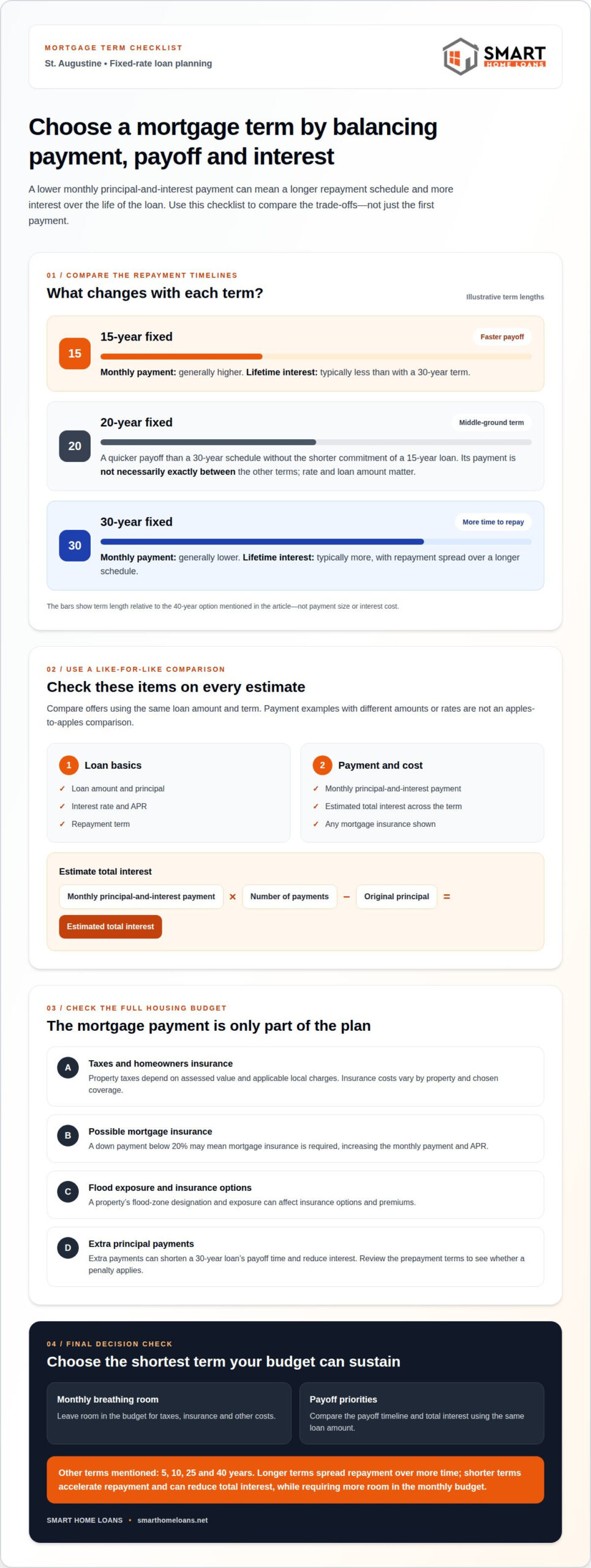
A fixed-rate mortgage keeps its interest rate unchanged throughout the loan. For example, a borrower paying 3% keeps that rate even if market rates fall to 2%. The 15-year and 30-year fixed-rate mortgage are popular choices, but their repayment schedules create different monthly commitments. A 15-year term generally has higher monthly payments and a faster payoff. A 30-year term usually lowers the monthly payment, while increasing interest paid over the loan’s life.
Compare the principal, interest rate, term, and estimated total interest. A shorter term often has a lower interest rate. Also include property taxes and insurance when planning your full housing budget. According to the Consumer Financial Protection Bureau, a down payment of less than 20% may mean mortgage insurance is required, increasing the monthly payment and APR.
To compare mortgage offers and prepare for preapproval in St. Augustine, review the same loan amount and term across each estimate. Compare the interest rate, APR, principal-and-interest payment, and any mortgage insurance shown. Gather your income, debts, and down-payment details for the application.
Property taxes depend on the home’s assessed value and applicable local charges. Homeowners insurance costs depend on the property and chosen coverage, so they can vary from one St. Augustine home to another.
Extra payments toward principal can shorten a 30-year loan’s payoff time and reduce interest. The loan’s prepayment terms determine whether a penalty applies, so review that clause before paying extra.
A property’s flood-zone designation and exposure can affect insurance options and premiums. Consider these costs alongside the mortgage payment when comparing homes in St. Augustine.
| Mortgage term | Monthly payment | Payoff and interest |
|---|---|---|
| 15-year fixed | Generally higher | Faster payoff; typically less total interest |
| 30-year fixed | Generally lower | Slower payoff; typically more total interest |
Choose the shortest term with a monthly payment that still leaves room in your budget for taxes, insurance, and other costs.
Example principal-and-interest payment estimates
Payment estimates depend on the loan amount, term, and interest rate, so compare matching assumptions. In St. Augustine, down payment, borrowed amount, and credit profile all help shape the offer and monthly payment; a down payment below 20% may mean mortgage insurance is required, according to the Consumer Financial Protection Bureau.
Monthly Payment Estimates
These examples use different amounts and rates, so they illustrate term options rather than an apples-to-apples comparison. Use a calculator to compare terms with the same loan amount and rate.
Total Interest Over the Loan
Total interest reflects the cost of borrowing across the full repayment schedule. To estimate it, multiply the monthly principal-and-interest payment by the number of payments, then subtract the original principal. A 15-year term has fewer payments and generally costs less interest over the loan’s life. A 30-year term typically costs more interest, even when its monthly payment is lower.
Interest Rates by Mortgage Term
In this comparison, 15-year mortgages typically have lower interest rates than 30-year mortgages. Still, compare the rate and APR alongside the payment, because the rate affects each payment and the interest accumulated over time. Down payment and credit profile also shape an offer. If your down payment is a key concern, explore down payment assistance as part of your planning.
Alternative mortgage terms, including 20-year loans
A 20-year mortgage sits between 15-year and 30-year loans by repayment time. For the 15 vs 30 year mortgage decision in St. Augustine, this middle term may suit borrowers seeking a quicker payoff than a 30-year schedule without the shorter commitment of a 15-year loan. Its payment won’t necessarily fall exactly between the other two, because the interest rate and loan amount also matter.
That figure illustrates one option, not a direct comparison with another term using the same amount and rate. Compare like-for-like estimates to see how the payment and total interest change. This makes a 20-year estimate useful when weighing the 15 vs 30 year mortgage options in St. Augustine.
Other possible terms include 10, 25, and 40 years, as well as five years. Longer terms spread repayment over more time and can mean lower monthly payments, but interest accrues over a longer schedule. Shorter terms accelerate repayment and can reduce total interest, while requiring more room in the monthly budget.
Start with a payment your budget can sustain alongside other housing costs. Then compare each term’s rate, total interest, and payoff timeline using the same loan amount. Include your credit profile when reviewing offers, as rates can vary between borrowers. The best fit balances a manageable payment with a repayment schedule that suits your financial priorities.
Compare mortgage options and identify a repayment term that fits your goals.
Smart Home Loans: FHA Home Loans
Smart Home Loans offers FHA Home Loans for borrowers weighing financing options alongside a mortgage term. The company also offers VA Loans, USDA Loans, and Jumbo Loans. After comparing payments, consider the type of financing and repayment schedule together, then assess how each fits your budget and goals.
Bring your preferred term and estimated payment into the conversation. That gives you a practical starting point for discussing which available loan option aligns with your plans. A 15-year, 20-year, or 30-year term affects the repayment timeline, so include that preference when exploring financing.
For a clearer next step, contact Smart Home Loans to discuss your mortgage options.
Choose a Mortgage Term That Supports Your Next Move
Think beyond the first payment. The right mortgage term should leave room for the plans you want to pursue while keeping repayment aligned with your longer-term priorities. For the 15-vs.-30-year mortgage decision in St. Augustine, write down what matters most: flexibility in your monthly budget, a faster payoff, or a balance between the two. Use that priority to guide your next conversation and compare financing choices with a clearer sense of direction.
Smart Home Loans can help you explore mortgage options suited to your financing needs. Bring your preferred term and goals to the discussion, then take the next step at Contact Smart Home Loans. A thoughtful plan can make the path to homeownership feel more manageable, one decision at a time.
Frequently Asked Questions
Taxes, homeowners insurance, and any mortgage insurance are additional costs, so this estimate isn’t the full monthly housing cost.
Which is better?
Neither term is automatically better. A 15-year loan can suit buyers who can comfortably manage its higher payment and want to repay sooner. A 30-year loan may fit buyers prioritizing lower monthly payments or more flexibility in their budget. Compare each option against your expected housing costs and financial priorities, not the term alone.
What are current 15-year and 30-year mortgage rates in St. Augustine, Florida?
There isn’t one rate for every St. Augustine borrower. Offers vary with market conditions, loan type, loan amount, down payment, and credit profile. Compare quotes for the same loan type and amount, and review both the interest rate and APR. APR helps compare broader borrowing costs, while the interest rate affects principal-and-interest payments.
What are the monthly principal and interest payments on a 15-year versus 30-year mortgage in St. Augustine?
These figures use different loan amounts and rates, so they don’t isolate the effect of the term. Taxes and insurance aren’t included.
How much total interest does a 15-year mortgage save compared with a 30-year mortgage?
Savings depend on the principal and the rate offered for each term, so there’s no single amount for every St. Augustine borrower. For a useful comparison, calculate the total scheduled principal-and-interest payments for each offer, then subtract the original loan amount. Compare identical loan amounts and include each term’s quoted rate to see the difference clearly.